Innovate your pharmaceutical compounding and custom‑manufacturing operations. Compounding pharmacies, cGMP custom dose‑manufacturers and service labs across the U.S. are routinely creating novel formulations, custom delivery systems, sterile processes, stability workflows and bespoke dosage protocols. Many of these activities satisfy the criteria for the federal R&D Tax Credit under IRC §41 (and often are eligible for state credits as well).
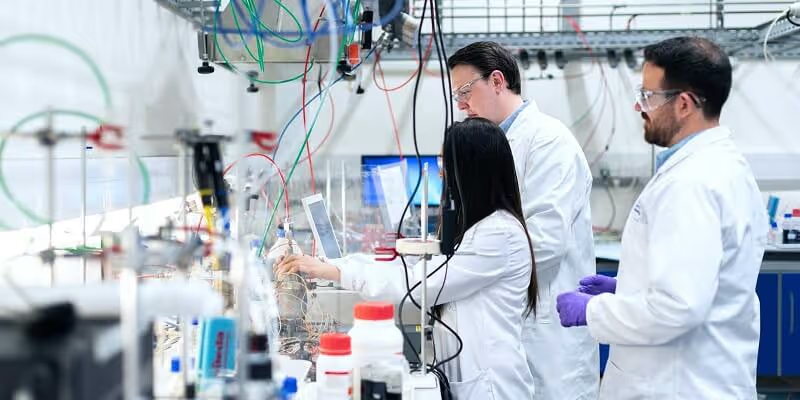

Examples of qualifying activities in compounding operations
- Formulation Development & Custom Delivery Creating unique compounded dosage forms (e.g., high‑viscosity topical gels, extended‑release multi‑dose units, nanoparticle suspensions, personalised blends) and testing delivery systems, dosing accuracy, compatibility.
- Stability & Compatibility Testing Conducting accelerated stability or real‑time stability of custom formulations, excipient screening, compatibility of APIs with novel containers or co‑dose systems, shelf‑life and impurity profiling via pilot studies.
- Analytical Method Development Designing or refining analytical assays to confirm potency, sterility, impurity profiles, bioavailability for custom compounds or unique delivery systems, side‑by‑side method validation.
- Process Innovation & Automation Developing automated blending/dispensing systems adapted for custom formulations, quick‑change tooling for niche batches, tracking trial yields, prototype machine/process testing of new compounding lines.
- Custom Patient‑Specific Manufacture & Workflow Design Testing patient‑specific dosage workflows, integration of sensors or monitoring in multi‑dose units, adapting packaging or delivery systems for compounded products (e.g., sensor‑enabled injectables, discrete dosing cartridges).
What qualifies as R&D in Compounding?
To qualify, your compounding or custom‑manufacturing activities must:
- Aim at a permitted purpose — such as a new or improved compounded formulation, innovative delivery or dosing system, custom patient‑specific dosage protocol, stability/compatibility study or advanced manufacturing process.
- Tackle technical uncertainty — for example: “Can this tailored dosage form maintain potency over the required shelf life?”, “Will the new pump/dispense system reliably deliver high‑viscosity formulation?”, “Can a multi‑dose, sensor‑enabled formulation reliably deliver medication under varied conditions?”
- Use a process of experimentation — formulation trials, stability studies, compatibility testing, side‑by‑side comparators of excipient systems, pilot manufacturing runs, dispense‑system benchmarking.
- Be technological in nature, grounded in pharmaceutical science, compounding engineering, materials science, process engineering, analytical chemistry or instrumentation/automation engineering.
Qualified Research Expenses (QREs)
Roles commonly involved in qualifying activities
- Formulation Scientists, Compounding Pharmacists, Pharmaceutical Engineers
- Analytical Chemists, Stability/Compatibility Specialists, Lab Technicians
- Process Engineers, Automation Engineers for dispensing/packaging systems
- QA/QC Engineers engaged in method validation or monitoring workflows
- Project Managers overseeing custom‑dose workflows, pilot runs and delivery systems
What does not qualify
- Routine compounding of existing formulations under standard recipes without experimentation or improvement
- Standard dispensing or manufacturing services without documented research or uncertainty
- Purely administrative tasks, sales or marketing operations
- Purchase of standard equipment or facility expansion not tied to a documented research or trial process
Compliance and Documentation
Following the One Big Beautiful Bill Act (OBBBA) signed July 4, 2025, §174 now allows immediate expensing of domestic research expenses for tax years beginning on or after January 1, 2025. Taxpayers may also elect optional amortization under new §174A. Foreign research expenses must still be amortized over 15 years. This is separate from the §41 credit but impacts overall tax planning.
Strong documentation is essential. Key records should include:
- Project briefs outlining objectives (e.g., reduce delivery‑system error by X%, extend shelf life by Y%), formulation trial logs, stability/compatibility trial logs.
- Side‑by‑side comparator logs of alternative excipient systems, dispense system prototype logs, yield/scrap data for pilot runs.
- Analytical method development logs, test/assay version histories, validation reports.
- Employee time‑tracking tied to research projects, payroll records of R&D staff, supply‑usage logs tied to experimentation.
- Version histories of formulation iterations, “failed” trial logs, acceptance‑criteria change logs — these all help demonstrate the process of experimentation.
Frequently Asked Questions
Yes — if they are performing new formulation development, custom delivery system design, stability or compatibility testing, automation or dispense‑system innovation, rather than simply routine compounding/batch runs.
Wages of scientists, engineers and qualified staff involved in research; materials and supplies consumed in trial/experiment; software or cloud tools used for modelling or analytics; third‑party vendor/lab costs for stability, compatibility or prototype testing.
Standard compounding operations without innovation or documented experimentation; routine dispensing/manufacturing; general business operations like marketing, sales, administrative or dispatch functions.
Maintain detailed logs of formulation development steps, stability/compatibility testing, dispense‑system trials, prototypes, side‑by‑side comparisons, employee time by project, supply usage tied to experiments, iteration logs including unsuccessful batches/trials.
Next Steps

Use our calculator to estimate your potential federal and state benefits

Schedule a consultation to structure your row crop research activities
If you are innovating in agriculture, you may already be doing R&D. Let's make sure you are rewarded for it.
Contact Strike Tax Advisory
Ready to maximize your R&D tax credits? Get in touch with our team of experts.

How much could I get back for
Compounding
?