Group 1
A black and white photo of a cross.
R&D Tax Credit CalculatorLogin
Contact Us
1-800-916-5165
Contact Us
Our team specializes in R&D credits and the ERTC, and can help you utilize these benefits to keep your company thriving.
Thank you! Your submission has been received!
Oops! Something went wrong while submitting the form.
By submitting your information above, you agree to receiving promotional emails and text messages using the contact info provided. Consent it not a condition to purchase. Message & data rates may apply.

Click to view our Terms of Service & Privacy Policy.
R&D Tax Credit Calculator
R&D Tax Credit
Industries
State R&D Credits
JournalsFAQs
About Us
Contact Us
A black and white photo of a cell phone.
Back
State R&D Credits
Active R&D Tax Credit States
A purple background with a black border.A purple background with a black border.
Alaska
Arizona
Arkansas
California
Colorado
Connecticut
Delaware
Florida
Georgia
Hawaii
Idaho
Illinois
Indiana
Iowa
Kansas
Kentucky
Louisiana
Maine
Maryland
Massachusetts
Michigan
Minnesota
Mississippi
Missouri
Nebraska
New Hampshire
New Jersey
New Mexico
New York
North Dakota
Ohio
Oregon
Pennsylvania
Rhode Island
South Carolina
Texas
Utah
Vermont
Virginia
Wisconsin
Inactive R&D Tax Credit States
A purple background with a black border.A purple background with a black border.
Alabama
District of Columbia
Montana
Nevada
North Carolina
Oklahoma
South Dakota
Tennessee
Washington
West Virginia
Wyoming
A black and white photo of a cell phone.
Back
All Industries
Aerospace & Defense
A purple background with a black border.A purple background with a black border.
Aerospace Engineering
Aviation
Firearms, Ammunition, & Missile Defense
Government Contractors
Jet Propulsion & Rocketry
Satellite Technology
Space Exploration
Agriculture
A purple background with a black border.A purple background with a black border.
Row Crops
Alcoholic Beverages
A purple background with a black border.A purple background with a black border.
Craft Breweries and Cideries
Distilleries
Hard Seltzers
Ready-to-Drink Cocktails
Wineries / Vineyards
Food & Beverage
A purple background with a black border.A purple background with a black border.
Co-Packing
Dairy Processing
Frozen Foods
Meat & Seafood Processing
Packaged Foods
Plant-Based Businesses
Industrial Hemp & CBD
A purple background with a black border.A purple background with a black border.
For more information about the R&D Tax Credit for Hemp and CBD sub-industries,
please visit www.hemptaxcredit.com
Manufacturing
A purple background with a black border.A purple background with a black border.
Agriculture
Apparel & Textiles
Automotive & Original Equipment Manufacturers (OEMs)
Chemicals
Consumer Packaged Goods
Electronics
Food & Consumer Packaging
Industrial Automation
Metals & Alloys
Oil & Gas
Plastic Injection Molding
Robotics Manufacturing
Semiconductors
Shipbuilding & Marine
Tool & Die
Medical & Pharmaceutical
A purple background with a black border.A purple background with a black border.
Analytic Research Laboratories
Clinical Trials
Compounding
Generic Drug Development
Medical Devices
Medical Equipment Manufacturers
Orphan Drug Development
Packaging
Pharmaceutical Development / Reformulation
Reagent Development
Vaccines
Software & Technology
A purple background with a black border.A purple background with a black border.
Artificial Intelligence
Blockchain
Cryptocurrency
Cybersecurity
Electronics
FinTech
Robotics
Telecommunications
VR/AR Development
Video Game Development
A black and white photo of a cell phone.
Back
R&D Tax Credit
Payroll Tax Credit
Credits by State
Credits by Federal
Section 174
Frequently Asked Questions
Payroll Tax Credit
A purple background with a black border.A purple background with a black border.
The Payroll Tax Credit is an extension of the R&D Tax Credit that allows qualified small businesses (QSBs) to use their federal R&D tax credits to offset their payroll. Learn more about the Payroll Tax Credit here.
A black and white photo of a cell phone.
Back
Media Room
Our Team
Partnership
Why Choose Strike
Payroll Tax Credit
A purple background with a black border.A purple background with a black border.
The Payroll Tax Credit is an extension of the R&D Tax Credit that allows qualified small businesses (QSBs) to use their federal R&D tax credits to offset their payroll. Learn more about the Payroll Tax Credit here.
humberger-icon
R&D Tax CreditIndustries
Aerospace & Defense
Agriculture
Alcoholic Beverages
Architecture & Engineering
Food & Beverage
Industrial Hemp & CBD
Manufacturing
Medical & Pharmaceutical
Software & Technology
Sub Industries
Aerospace EngineeringSpace ExplorationSatellite TechnologyJet Propulsion & RocketryGovernment ContractorsFirearms, Ammunition, & Missile Defense
Sub Industries
Row Crops
Sub Industries
Craft Breweries and CideriesDistilleriesHard SeltzersReady-to-Drink CocktailsWineries / Vineyards
Sub Industries
ArchitectureCivil EngineeringConstruction EngineeringElectrical EngineeringEnvironmental EngineeringLEED / Sustainable ArchitectureMechanical Engineering
Product EngineeringStructural Engineering
Sub Industries
Plant-Based Businesses
Packaged Foods
Meat & Seafood Processing
Frozen Foods
Dairy Processing
Co-Packing
For more information about the R&D Tax Credit for Hemp and CBD sub-industries,
please visit www.hemptaxcredit.com
Sub Industries
Apparel & TextilesAutomotive & Original Equipment
Manufacturers (OEMs)
Consumer Packaged GoodsChemicalsElectronicsFood & Consumer Packaging
Industrial AutomationMetals & AlloysOil & GasSemiconductorsRobotics ManufacturingShipbuilding & MarineTool & DiePlastic Injection Molding
Sub Industries
Analytic Research LaboratoriesClinical TrialsCompoundingGeneric Drug DevelopmentMedical DevicesMedical Equipment Manufacturers
Orphan Drug DevelopmentPackagingPharmaceutical Development / ReformulationReagent DevelopmentVaccines
Sub Industries
Artificial IntelligenceBlockchainCryptocurrencyCybersecurityElectronics
FinTechRoboticsTelecommunicationsVR/AR DevelopmentVideo Game Development
Active R&D Tax Credit States
Inactive R&D Tax Credit States
Alaska
Arizona
Arkansas
California
Colorado
Connecticut
Delaware
Florida
Georgia
Hawaii
Idaho
Illinois
Indiana
Iowa
Kansas
Kentucky
Louisiana
Maine
Maryland
Massachusetts
Michigan
Minnesota
Mississippi
Missouri
Nebraska
New Hampshire
New Jersey
New Mexico
New York
North Dakota
Ohio
Oregon
Pennsylvania
Rhode Island
South Carolina
Texas
Utah
Vermont
Virginia
Wisconsin
Wyoming
West Virginia
Washington
Tennessee
South Dakota
Oklahoma
North Carolina
Nevada
Montana
District of Columbia
Alabama
R&D Credit Calculator
Federal Credits
Credits by State
Payroll Tax Credit
Section 174
Frequently Asked Questions
Discover how much you can claim in R&D tax credits for expenditures on the development of new software, technology, products and processes. Calculate how much you’re owed.
Learn more about Federal Credits and recover up to 10% of your R&D spend from the IRS. Qualified small businesses can offset payroll taxes up to $250,000 per year.
Does your state offer R&D tax credits? Depending on the state where the R&D activities are performed, companies can offset various tax liabilities. Learn more about the R&D Tax Credits specific to your state.
The Payroll Tax Credit is an extension of the R&D Tax Credit that allows qualified small businesses (QSBs) to use their federal R&D tax credits to offset their payroll. Learn more about the Payroll Tax Credit here.
Due to the revisions made to Internal Revenue Code Section 174 under the TCJA, R&D expenditures are no longer deductible beginning in the 2022 tax year. Learn how Section 174 impacts your business.
Most companies don't believe they qualify for specialty business tax credits. Our Experts are here to demystify these credits. Check our frequently asked questions about R&D tax credits.
Case Study
Media Room
Our Team
Partnership
Why Choose Strike
Discover how businesses like yours saved thousands of dollars in R&D tax credits to reinvest in growth. Learn more about the real-life examples here.
Check out our latest news and media mentions. Be the first to learn how the tax credit landscape is evolving.
Our team is built from some of the world’s most educated firms. We specialize in various technical disciplines as CPAs, attorneys, scientists, engineers, and techpreneurs. Meet our team.
Strike empowers accountants, CPAs, and financial consultants to offer top-tier R&D tax credit advisory services without hassle, investment, or risk. Join 250+ partners who trust Strike to maximize their clients’ tax benefits.
Strike Tax Advisory was created with the belief that innovators deserved a better way to claim the tax credits they are entitled to. Learn why 800+ clients and 250+ partners choose Strike.
State R&D CreditsJournalFAQsAbout Us
Strike on Software Social Podcast: Can the R&D Tax Credit Offset the Section 174 Changes?
Check Now
HomeIndustriesManufacturingChemicals

Chemicals R&D Tax Credits

Unlock savings on chemical innovation, formula development and process enhancement. Chemical manufacturers, formulators, intermediates producers, polymer specialists, coatings and specialty‑chemical firms in the U.S. invest heavily in new compounds, reactions, process scale‑up and sustainability innovations — and many of these expenditures qualify for the federal R&D Tax Credit under IRC §41 plus state‑based incentives.

Estimate your CreditsBook a Consultation
partner-hero-bg

Examples of qualifying activities in chemicals production

  • Formula & Polymer Innovation Developing a new coating polymer with improved adhesion and lower VOC emissions, experimenting with catalysts for alternative feedstocks, medium‑scale trials of novel intermediates.
  • Process & Reaction Scale‑Up Translating a bench‑scale reaction to pilot/plant scale, adjusting reaction parameters (temperature/pressure/time) to optimise yield, reducing cycle time, minimizing by‑product formation, validating through instrumentation and analytics.
  • Manufacturing Line/Equipment Innovation Installing or adapting specialised reactors, sensor systems, process‑control automation, waste‑heat recovery, inline analytics, advanced mixing or separation methods, pilot trial runs for new feedstock or reaction technology.
  • Sustainability & Environmental Enhancement Replacing fossil feedstocks with bio‑based alternatives, designing processes requiring less water/energy, trialling novel waste‑reduction or recycling loops, validating new process controls or sensors for emissions monitoring.
Speak to an Expert

What qualifies as R&D in the chemical manufacturing sector?
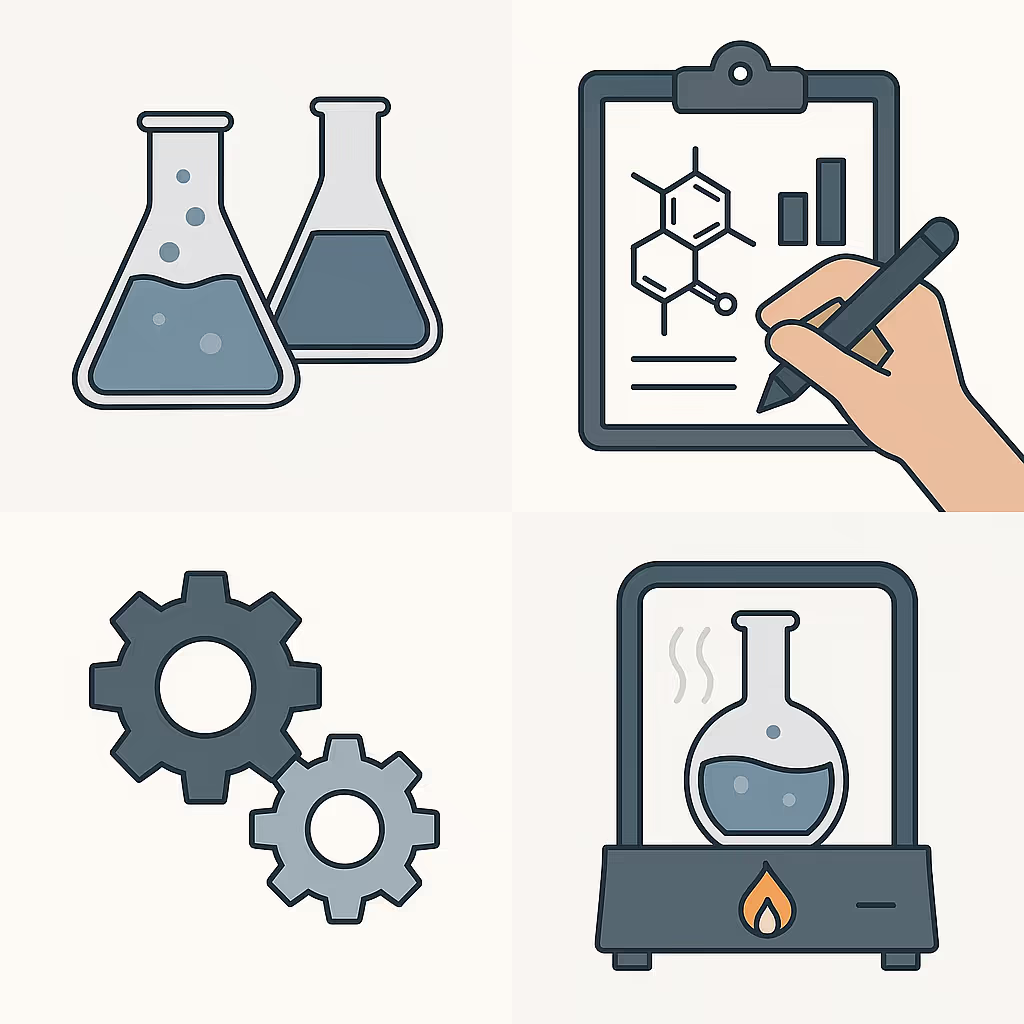
To qualify, your chemical‑industry activities must:

  • Aim at a permitted purpose — such as a new or improved chemical formula, intermediate, polymer/excipient, new catalyst, a process improvement (yield, cycle time, energy‑use), or sustainability enhancement (lower waste, greener feedstocks).
  • Tackle technical uncertainty — for example: “Can this new polymer blend achieve target mechanical properties and processing tolerances while reducing toxic‑by‑products?”, “Will a scaled‑up reaction from lab‑bench deliver the same yield and safety profile in production environment?”, “Can a new catalyst reduce reaction time by 30% while maintaining product quality and regulatory compliance?”
  • Use a process of experimentation — including lab‑scale formulation testing, pilot‑batches, process modelling, alternative route trials, failure analysis, scale‑up validation, process‑design iterations.
  • Be technological in nature — grounded in chemical engineering, materials science, process engineering, analytical chemistry, instrumentation/automation, or software modelling of chemical processes.
Get a Free Assessment

Qualified Research Expenses (QREs)

In the chemical sector, relevant expense categories include:

Expense Type
Examples in Chemicals
Eligibility Notes
Wages
Analytical chemists, chemical/process engineers, lab technicians, pilot‑plant engineers, automation/control engineers
Direct, supervisory and support personnel may qualify
Supplies
Lab chemicals, catalyst/film materials, pilot‑batch feedstocks, reaction consumables, sensors/analytics equipment
Must be consumed/used in the research experimentation
Software / Cloud
Process‑modelling software, reaction simulation tools, data‑analytics platforms for pilot/scale‑up runs
Eligible if integral to experimentation
Contract Research
Third‑party labs performing analytical tests, external engineers certifying new catalysts, specialist pilot‑line vendors
Often up to ~65% of contract costs may qualify
Estimate your Credits

Roles commonly involved in qualifying activities

  • Chemical/process engineers developing new reactions or process scale‑up
  • Analytical chemists or research scientists validating new compounds or catalysts
  • Automation/control engineers installing process‑monitoring systems or inline analytics
  • Pilot‑plant engineers managing small‑scale trials and transition to production
  • Sustainability engineers leading replacements of feedstocks or waste‑reduction loops
  • External research labs or specialized materials/catalyst testers validating new chemistries
Contact Us Now

What does not qualify

  • Routine production of known compounds or intermediates without experimentation or technical uncertainty
  • Standard scale‑up of production using established methods without modifications/trials
  • General business functions: sales, marketing, administrative tasks, order fulfilment
  • Land acquisition, building expansions, or standard machine purchases not tied to an active research/test program
Speak to an Expert

Compliance and Documentation

§174 Update

Following the One Big Beautiful Bill Act (OBBBA) signed July 4, 2025, §174 now allows immediate expensing of domestic research expenses for tax years beginning on or after January 1, 2025. Taxpayers may also elect optional amortization under new §174A. Foreign research expenses must still be amortized over 15 years. This is separate from the §41 credit but impacts overall tax planning.

Recommended documentation for chemical‑industry R&D:

  • Project briefs/hypotheses (e.g., “Will a new catalyst reduce reaction time by 25% while maintaining >99% purity and reducing by‑products by 15%?”, “Scale‑up of polymer reaction from 10 kg to 1000 kg while maintaining mechanical properties within spec”)
  • Lab/trial logs: reaction conditions, yield/time data, failed experiments and alternatives, pilot‑plant test sheets, analytics and instrumentation outputs
  • Time‑tracking for engineers/scientists/support staff engaged in the experimentation
  • Invoices for feedstocks, materials, sensors/analytics equipment, contract lab services; pilot‑batch data; scale‑up test results
  • Version history: iterations of chemistry, process parameters, equipment changes, sample test results, process data and conclusions/next‑steps Maintaining robust documentation helps satisfy the §41 four‑part test (permitted purpose, technical uncertainty, process of experimentation, technological in nature).
Schedule a Call with an Expert

Frequently Asked Questions

Do chemical or specialty‑chemical companies qualify for the R&D Tax Credit?
mness-logo
line-logo

Yes — if your company is developing new or improved formulas, catalysts, polymer blends, scaling up novel processes, implementing process‑control/automation systems, or investigating sustainability innovations rather than executing routine production.

What expenses can be claimed?
mness-logo
line-logo

Wages for scientists/engineers, supplies consumed in experimentation (chemicals, catalysts, pilot‑batch feedstocks), software tools for modelling/analytics, and third‑party contract research services connected to R&D programmes.

What activities typically qualify?
mness-logo
line-logo

Developing a new coating polymer, scaling a lab‑reaction to pilot/plant scale, integrating sensors for process monitoring, trialling bio‑based feedstocks, performing process‑control automation for yield optimisation, reducing energy or water footprint in reaction systems.

What kinds of activities do not qualify?
mness-logo
line-logo

Routine manufacturing runs of known chemicals without experimentation, standard scale‑up following proven process without modification/tests, general business/support tasks, equipment purchases solely for production scaling without a research/test component.

How much can chemical companies typically save?
mness-logo
line-logo

Credit value depends on size of innovation, years of eligible spending and documentation quality. Many chemical‑industry firms that properly document their R&D enjoy credit values in the range of ~20‑22% of qualified research expenses (federal + state combined) when optimised.

How should a chemical company document research activities?
mness-logo
line-logo

Keep project briefs/hypotheses (e.g., “Will new catalyst achieve same conversion in 30% less time at scale while reducing by‑product formation by 10%?”), track trial logs, record failed alternatives, employee/time‑tracking records, invoices for materials/analytics/third‑party services, pilot‑scale data, process‑iteration summaries, and next‑step conclusions.

Next Steps

Estimate Credits
Estimate Credits

Use our calculator to estimate your potential federal and state benefits

Estimate your Credits
Speak to Expert
Speak to Expert

Schedule a consultation to structure your row crop research activities

Book a Consultation

If you are innovating in agriculture, you may already be doing R&D. Let's make sure you are rewarded for it.

Our Client Success Stories

Boost Your Bottom Line with Strike Tax.

Specialty Polymer Manufacturer

Total R&D Credit Received
$1,050,000
Employee Count
180
Qualification Outcome
55% of wages paid and 75% of chemical feedstock expenses

Industrial Coatings Formulator

Total R&D Credit Received
$920,000
Employee Count
95
Qualification Outcome
50% of wages paid, 70% of supplies paid, and 65% of contract analytics costs
See How We Can Help You

Contact Strike Tax Advisory

Ready to maximize your R&D tax credits? Get in touch with our team of experts.

Our team of experts is here to help.
By submitting your information above, you agree to receiving promotional emails and text messages using the contact info provided. Consent it not a condition to purchase. Message & data rates may apply.
‍
Click to view our Terms of Service & Privacy Policy.
Check mark-circle
Thank You!
Your information has been successfully sent!
Want to speed up the qualification process?
Book Your consultation Now
Oops! Something went wrong while submitting the form.

Need more info? Schedule a time to connect with our team.

Schedule a Meeting
Schedule a Meeting

How much could I get back for

Chemicals

?

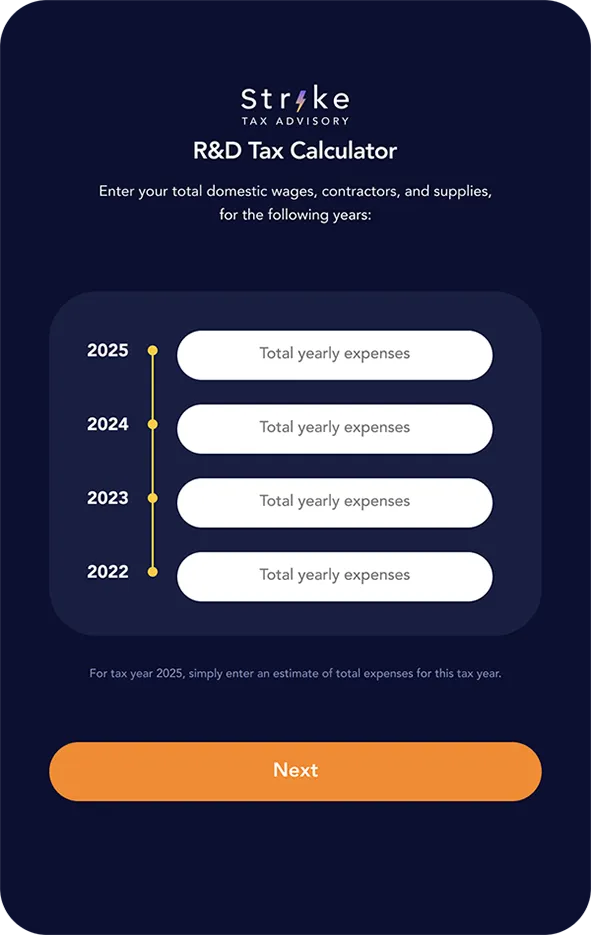
Great question! Try out our R&D Tax Credit Calculator to see the value of your R&D tax credit reward.
Thank you! Your submission has been received!
Oops! Something went wrong while submitting the form.
A black background with a lightning symbol.
a screenshot of a tax calculatora screenshot of a tax calculator
Company
Contact UsStrike TeamWhy Choose StrikeMedia RoomWe're Hiring!Privacy PolicyPrivacy Policy
Resources
R&D Tax Credit CalculatorState R&D CreditsU.S. R&D Tax CreditsPayroll TaxesJournalFAQs
Subscribe
Thank you! Your submission has been received!
Oops! Something went wrong while submitting the form.
The logo for strike tax advisory.
2025 © Strike Tax Advisory
Terms of ServicePrivacy Policy