Accelerate innovation in factory automation, robotics integration and smart manufacturing systems. Industrial automation companies routinely develop control systems, sensors, machine‑learning integration, customised robots, and process‑improvement technologies—and many of these efforts meet the criteria for the federal R&D Tax Credit under IRC §41, plus state credits.
.avif)

Examples of qualifying activities in automation & smart manufacturing
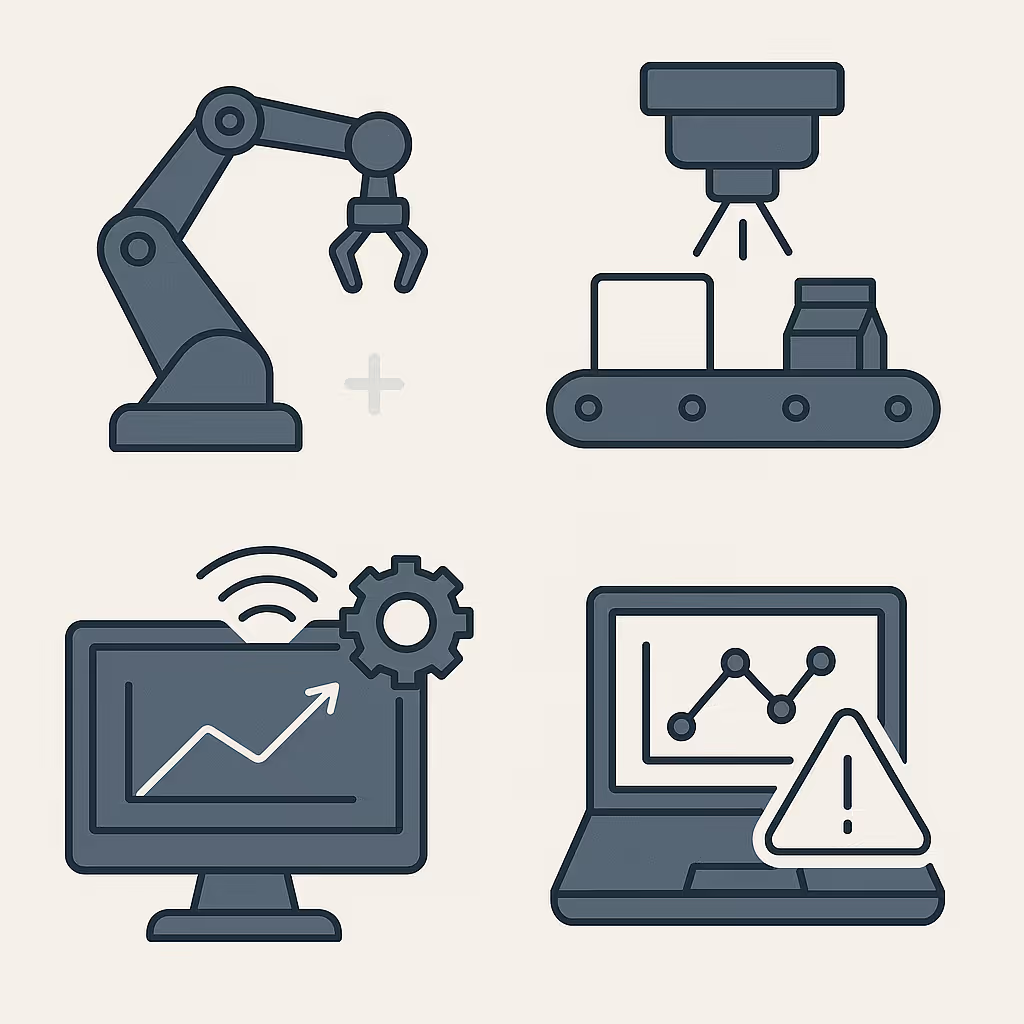
- Robotic & Vision System Development Designing custom robotic end‑effectors, integrating machine‑vision inspection, testing path optimization for multiple SKUs, benchmarking accuracy and cycle time in pilot cells.
- Flexible Production Line & Change‑over Optimization Developing quick‑change tooling systems, reconfigurable automation cells for small batch/high‑mix production, sensor systems to auto‑adapt to product changes, pilot trials measuring change‑over time and defect rates.
- IoT/Sensor‐Driven Predictive Maintenance & Digital Twin Deploying sensors, analytics, machine‑learning models for equipment health prediction, running pilot studies of sensor networks, modelling/digital‑twin simulation of throughput and downtime, iterating algorithm parameters.
- Process Efficiency & Waste Reduction Automating formerly manual workflows, redesigning tooling and fixturing for higher throughput, implementing real‑time data feedback loops, pilot runs measuring bottleneck reduction, scrap yield improvement.
- Sustainability & Smart Manufacturing Integrating energy‑monitoring sensors, optimizing machine run‑time, automating idle‑time reduction, piloting new software/hardware combos to reduce energy/consumable usage, process redesign to reduce waste.
What qualifies as R&D in Industrial Automation?
To qualify, your automation‑industry activities must:
- Pursue a permitted purpose — such as a new or improved automation system, machine‑vision integration, flexible production line, predictive‑maintenance algorithm, robotic end‑effector design, or integration of IIoT sensors and analytics for throughput improvement.
- Address technical uncertainty — for example: “Can the new vision‑inspection system detect defects at 0.1 mm size on a high‑speed line while keeping cycle time ≤ 1.2 s?”, “Will the flexible robotic cell reliably switch between multiple part families without manual re‑tooling downtime?”, “Can we implement predictive‑maintenance analytics to reduce unplanned downtime by 50% in a mixed‑model manufacturing line?”
- Follow a process of experimentation — prototyping, simulation modelling, pilot‑line trials, sensor/vision algorithm testing, robot path‐optimisation, data‑analytics iteration.
- Be technological in nature, grounded in controls/automation engineering, robotics, sensor/vision systems, data science/analytics, mechanical engineering of production assets, or software‑hardware integration.
Qualified Research Expenses (QREs)
In industrial automation and smart manufacturing the IRS recognises:
Roles commonly involved in qualifying activities
- Automation/control engineers designing and integrating new robotic cells or sensor systems
- Robotics programmers and vision system developers working on detection, pick‑and‑place or adaptive cell logic
- Data scientists/analytics engineers creating predictive models, digital twins, IoT sensor networks
- Process/manufacturing engineers managing pilot lines, measuring throughput/yield improvement, assessing change‑over performance
- R&D technicians or trial staff conducting pilot runs, collecting performance/failure data, tracking iterative enhancements
- External systems integrators or research labs contracted for pilot studies
What does not qualify
- Routine automation installation or retrofit projects without experimentation or technological uncertainty (for example: installing a standard robot to replicate existing cycle exactly)
- General business support, sales, administration, customer service or maintenance activities unrelated to research
- Using known automation line without trial or improvement of process, technology or algorithm
- Land acquisition, building expansion or standard equipment purchases not tied to a documented research/test program
Compliance and Documentation
Following the One Big Beautiful Bill Act (OBBBA) signed July 4, 2025, §174 now allows immediate expensing of domestic research expenses for tax years beginning on or after January 1, 2025. Taxpayers may also elect optional amortization under new §174A. Foreign research expenses must still be amortized over 15 years. This is separate from the §41 credit but impacts overall tax planning.
Documentation remains essential — automation companies should maintain records including:
- Project briefs (e.g., “Deploy flexible robotic cell capable of three product families with change‑over time <2 minutes; test 10 pilot runs”)
- Pilot‑line layouts, simulation logs, robot path/vision algorithm iteration histories, change‑over logs, defect yield before/after
- Time‑tracking records for engineers/technicians on R&D tasks, payroll tied to research projects
- Version histories (robot end‑effector designs, vision‐software updates, control algorithm revisions), failed trials/fallbacks
- Data‑analytics logs, sensor network trial results, downtime/yield metrics, energy/consumption reductions Strong documentation supports the §41 four‑part test and helps during audits.
Frequently Asked Questions
Yes — if your organisation is developing new or improved automation/control systems, robotic cells, sensor/vision integrations, analytics/digital‑twin solutions, or other technical experiments rather than standard production or installation.
Wages of R&D and trial staff, prototype or sensor/robot consumables, simulation/analytics software, third‑party integrator or lab services tied to qualified research.
Examples include: building a pilot flexible robotic cell for mixed‑model production, implementing machine‑vision defect detection with new algorithm, deploying sensor network for predictive maintenance and validating results in a pilot factory, redesigning tooling/fixture system to reduce cycle time via automation trial.
Routine automation or installation of known robots without experiment, production ramp‑up of standard lines, marketing/sales/administration functions, standard equipment purchases for scaling existing process without research.
Varies by scope and documentation; many firms capture incentives that approach ~22% of their qualified research expenses when activities are well‑documented and aligned with IRS guidelines.
Maintain project hypotheses (e.g., “Can the new vision‑inspection algorithm reduce false rejects by 40% while maintaining throughput >1,500 units/hour?”), pilot‑run logs, path/algorithm version history, robot program revisions, time‑tracked R&D payroll, sensor/analytics output logs, before/after throughput/yield metrics.
Next Steps

Use our calculator to estimate your potential federal and state benefits

Schedule a consultation to structure your row crop research activities
If you are innovating in agriculture, you may already be doing R&D. Let's make sure you are rewarded for it.
Contact Strike Tax Advisory
Ready to maximize your R&D tax credits? Get in touch with our team of experts.

How much could I get back for
Industrial Automation
?