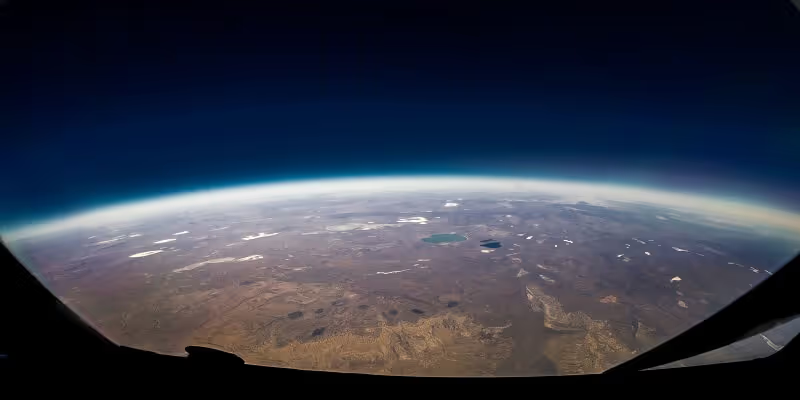
Fuel your mission with tax credits. From launch systems and orbital logistics to deep‑space communication and in‑space manufacturing, companies operating in space exploration are often eligible for the federal R&D Tax Credit under IRC §41. If your team is designing, testing, or troubleshooting space technologies under technical uncertainty — there’s a good chance those efforts qualify.

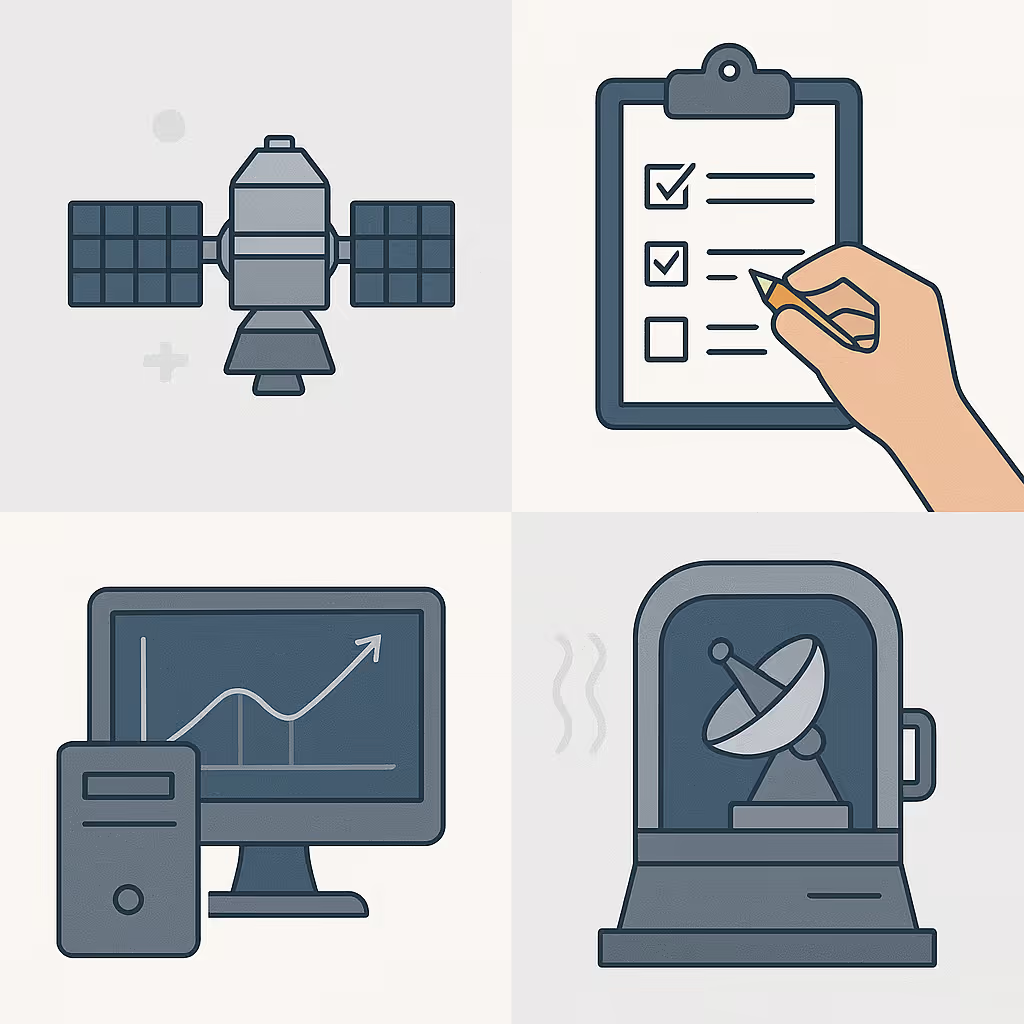
Examples of Qualifying Space R&D Activities
- Reusable Launch Vehicle Development Designing and testing reusable boosters, conducting re-entry simulations, evaluating turnaround timelines, running thermal protection experiments.
- In-Space Manufacturing & Assembly Systems Prototyping microgravity 3D printing tools, robotic arms, ISRU systems (e.g., regolith-to-structure), and validating cycle-time, material flow, and bonding strength in orbital testbeds.
- Autonomous Docking, Rendezvous & Refueling Developing onboard vision/targeting algorithms, LIDAR/IR sensing integration, autonomous control schemes, and orbital constraint navigation under time delay.
- Radiation-Hardened Electronics & Structures Testing payload and subsystem resistance to solar flares or Van Allen exposure, analyzing data retention after burst events, validating ECC protocols.
- Orbital Debris Avoidance & Servicing Systems Building adaptive thrust-vector systems, deploying robotic arms or nets for active debris capture, or testing on-orbit refueling and maintenance payloads.
- Lunar & Deep-Space Mission Simulation Designing simulation environments to replicate long-duration deep space exposure, reduced-gravity response, or long-latency comm networks (DTN).
What Qualifies as R&D in Space Exploration?
To qualify, your space R&D must:
- Aim at a permitted purpose — like building or improving a spacecraft system, propulsion subsystem, space-based communication network, or in-orbit manufacturing platform.
- Address technical uncertainty — such as, “Can we develop autonomous rendezvous under orbital drift conditions?”, “Will this material survive repeated thermal cycling in cislunar orbit?”, “Can we reduce propellant use while meeting mission delta‑V?”
- Use a process of experimentation — through simulation, hardware iteration, vacuum testing, thermal/vibration chambers, or suborbital trials.
- Be technological in nature — rooted in aerospace, propulsion, materials, avionics, control systems or autonomy.
This includes both government and commercial spaceflight programs — as long as you retain risk and rights over the R&D.
Qualified Research Expenses (QREs)
Common Roles in Qualifying Space R&D
- Space systems engineers and mission architects
- Autonomy/control engineers
- Propulsion R&D specialists
- Thermal/environmental simulation staff
- Robotics engineers (on-orbit servicing, mobility)
- Aerospace test lab operators
What does not qualify
- Launch or mission operations using already-proven hardware
- Passive use of off-the-shelf technologies without redesign/testing
- Sales, compliance, admin, or public affairs roles
- Capital equipment unrelated to testing (e.g., trucks, office servers)
- Fully reimbursed work with no retained IP or technical risk
Compliance and Documentation
Following the One Big Beautiful Bill Act (OBBBA) signed July 4, 2025, §174 now allows immediate expensing of domestic research expenses for tax years beginning on or after January 1, 2025. Taxpayers may also elect optional amortization under new §174A. Foreign research expenses must still be amortized over 15 years. This is separate from the §41 credit but impacts overall tax planning.
What to Document:
- System-level design challenges and mission requirements
- Simulation logs (docking, orbit decay, latency buffering)
- Vacuum/thermal chamber results, pre-launch verifications
- Robotics/autonomy tuning logs and rework versions
- Time sheets for engineers and test crew
- Logs of failed test outcomes or alternate system paths
Proper documentation proves experimentation — and supports claims during an IRS or state review.
Frequently Asked Questions
Yes — if they’re creating or improving launch vehicles, communication systems, orbital robotics, or in-space operations under technical uncertainty, and are documenting the research effort.
Engineering/test personnel wages, consumed supplies (prototypes, shielding), relevant software, and outside research contracts — as long as your company retains risk and technical control.
Routine launches or ops without experimentation, using commercial hardware with no change/testing, or reimbursed government research with no rights or risk.
Well-documented firms often recover 10% to 15% of their qualified expenses — and more when layering in state credits
Focus on simulation vs. field test logs, version control, subsystem test reports, time tracking by project, and documentation of rework/redesign based on failed criteria or test outcomes.
Next Steps

Use our calculator to estimate your potential federal and state benefits

Schedule a consultation to structure your row crop research activities
If you are innovating in agriculture, you may already be doing R&D. Let's make sure you are rewarded for it.
Contact Strike Tax Advisory
Ready to maximize your R&D tax credits? Get in touch with our team of experts.

How much could I get back for
Space Exploration
?