Maximize innovation in AI. AI developers and enterprises across the U.S. are continuously building, refining and deploying advanced systems—from machine‑learning models to natural language processing frameworks. Many of these activities qualify for the federal R&D Tax Credit under IRC §41, with additional opportunities at the state level.


Examples of qualifying activities in AI development
- Algorithm & Model Development Designing new machine‑learning architectures, neural network topologies, or generative models that improve performance, accuracy or efficiency.
- Data Pipeline & Pre‑Processing Experiments Creating novel data cleaning, feature engineering or training‑data augmentation methods; experimenting with large‑scale data sets or unsupervised learning.
- Integration & Deployment Trials Embedding AI within existing systems (e.g., automating decision flows, integrating with robotics or IoT devices), testing for scalability, latency, or reliability.
- Natural Language & Computer Vision Research Developing language‑understanding systems, image recognition or multi‑modal AI; experimenting with novel architectures, training methods or deployment scenarios.
- Cloud / Compute Optimization Experimenting with distributed training, GPU/TPU orchestration, data‑parallel processing, or novel compute routes to reduce costs or speed.
- Responsible AI & Safety Research Addressing technical questions around model robustness, interpretability, bias mitigation, or adversarial‑attack resistance (in many cases, these too meet R&D criteria).
What qualifies as R&D in Artificial Intelligence?
To qualify, activities must:
- Pursue a permitted purpose such as a new or improved product, process, or technique (for example, a novel AI model, or a superior algorithm).
- Address technical uncertainty about capability, method or design (e.g., can the model learn reliably, can the architecture scale, can accuracy or latency be improved?).
- Follow a process of experimentation through modeling, simulation, algorithmic testing, iteration, or A/B trials.
- Be technological in nature, grounded in computer science, data engineering, algorithm design, neural networks, cloud/compute architecture or other hard‑science principles.
Qualified Research Expenses (QREs)
Roles commonly involved in qualifying activities
- Machine Learning Engineers, Data Scientists & Algorithm Researchers
- Software Engineers and Platforms Engineers working on AI infrastructure
- Cloud Architects, GPU/TPU Engineers and DevOps focused on model deployment
- Data Engineers and Feature‑Engineering Specialists
- Research Partners: universities, research labs and external contractors
What does not qualify
- Routine AI system maintenance or generic bug‑fixing without experimentation or innovation
- Applying off‑the‑shelf AI tools without modification to internal R&D or improvement
- Administrative, marketing, sales or general management tasks
- Land acquisition, capital improvements or general operational expenditures that do not tie directly into experimentation or development
Compliance and Documentation
Following the One Big Beautiful Bill Act (OBBBA) signed July 4, 2025, §174 now allows immediate expensing of domestic research expenses for tax years beginning on or after January 1, 2025. Taxpayers may also elect optional amortization under new §174A. Foreign research expenses must still be amortized over 15 years. This is separate from the §41 credit but impacts overall tax planning.
Documentation remains critical. Maintain clear records of:
- Project goals, hypothesis, and technical uncertainty defined at the start
- Experiment design, iterations, testing logs, outcomes and next‑step decisions
- Time tracking by project, role and research vs non‑research activity
- Material/supply usage, cloud compute hours, contractor engagement Good documentation supports the IRS Four‑Part Test and strengthens audit readiness.
Frequently Asked Questions
Yes. Companies actively engaged in developing or improving AI systems—where there is testing, iteration or experimentation—can qualify under §41. For example, building or improving generative AI models, embedding AI in business processes, or optimizing AI infrastructure are potential qualifying activities.
Wages of employees engaged in qualifying research, supplies used in the development process, cloud or computing costs tied to experiments, and certain contract research costs.
Projects such as developing new algorithms, improving model efficiency/accuracy, extracting insight from large data sets, integrating AI into novel platforms, or experimenting with novel compute architectures may qualify.
Routine AI deployment without innovation, use of standard off‑the‑shelf AI tools without experimentation, general IT or business tasks, ledger deployments with no unresolved technical uncertainty.
Savings vary widely based on size, extent of R&D activity, and documentation practices. Many active AI firms find six‑figure credit amounts when properly documented—especially where large payroll/compute spend is directed to innovation.
Maintain clear project charters defining hypotheses and uncertainties, logs of modeling/testing/iteration, compute usage and cost breakdowns, time‑allocation by research vs non‑research tasks, and internal/external reporting of outcomes. This will support the Four‑Part Test and audit readiness.
Next Steps

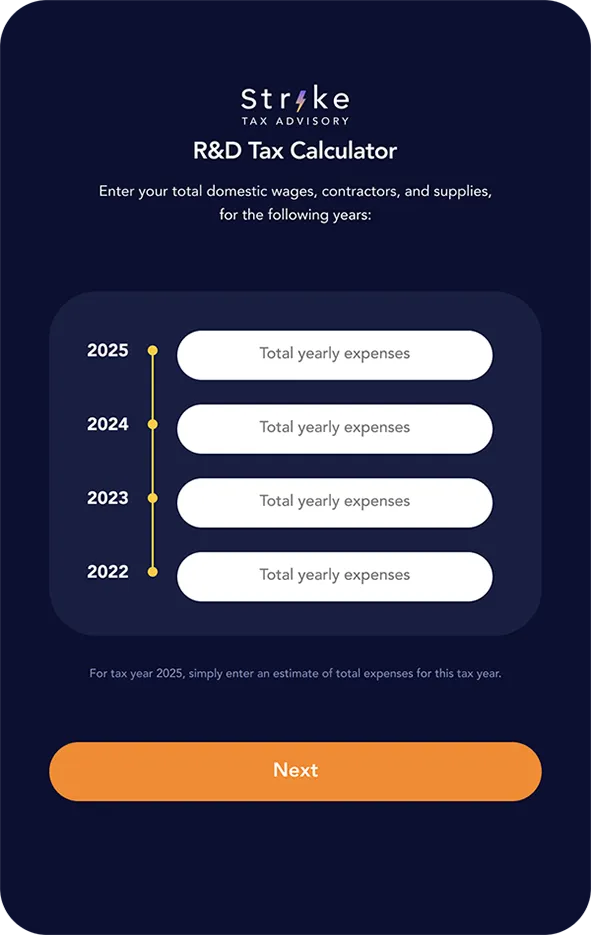
Use our calculator to estimate your potential federal and state benefits

Schedule a consultation to structure your row crop research activities
If you are innovating in agriculture, you may already be doing R&D. Let's make sure you are rewarded for it.
Contact Strike Tax Advisory
Ready to maximize your R&D tax credits? Get in touch with our team of experts.

How much could I get back for
Artificial Intelligence
?