
R&D Tax Credit Insights & Analysis
Expert guidance on federal and state R&D tax credits from Strike Tax Advisory's team of CPAs, attorneys, and engineers.
Strike Tax Advisory publishes in-depth analysis on R&D tax credit law, IRS compliance, Section 174 developments, and OBBBA updates. Our journal is written by tax credit specialists who have delivered over $300M+ in credits for American businesses. All content references official IRS, Congressional, and legal sources only.

Minnesota Refunds Unused R&D Credits for 2025 and 2026: What That Is Worth
August 19, 2026
Paul Sassano
Minnesota's R&D credit became partially refundable for tax years beginning after December 31, 2024. The election is irrevocable, it reaches only the current year credit, and for S corporations and partnerships the owners make it, not the business.
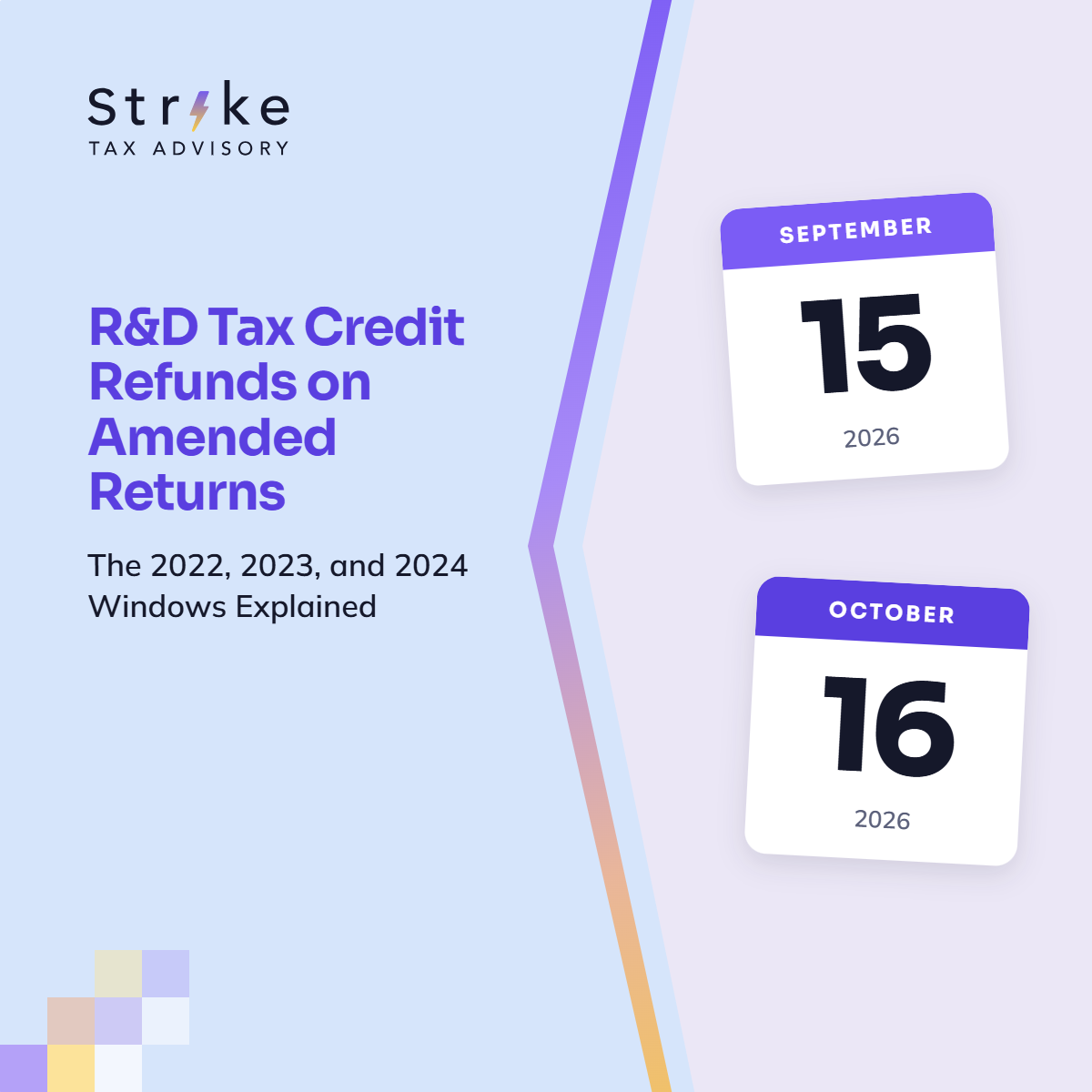
R&D Tax Credit Refunds on Amended Returns: The 2022, 2023, and 2024 Windows Explained
August 12, 2026
Paul Sassano
The July 6, 2026 deadline closed a Section 174A election, not the R&D credit itself. 2023 and 2024 remain open, and many extended 2022 filers have until September or October 2026. This guide covers how the three-year refund window is measured, the outside date for each open year, the three items the IRS requires in a valid claim, the right amendment form for each entity type, and how state credits follow the same path.

After the July 6 Section 174A Deadline: What Happens Next?
July 14, 2026
Jonathan Cardella
July 6, 2026 closed the retroactive Section 174A election window. What happens next depends on whether your amended return changed Section 174A, Section 41, or both. This guide covers IRS processing timelines, Letters 6426C and 6428, the 45-day perfection window through January 10, 2027, Joint Committee review, refund interest, and the paths that remain open if you missed the deadline.


Form 6765 Section G Becomes Mandatory in 2026. Most AI-Only R&D Credit Tools Will Not Be Ready.
May 28, 2026
Paul Sassano
Section G of Form 6765 is mandatory for tax years beginning in 2026, requiring business-component reporting and detailed QRE breakdowns that AI-only questionnaire tools were not built to produce. Plus the closing Section 174A amendment window for 2022 through 2024.

R&D Tax Credit for Agriculture: What George v. Commissioner Means for Row Crops and Livestock
May 4, 2026
Jonathan Cardella
The Tax Court ruling in George v. Commissioner confirmed agriculture qualifies for the R&D tax credit under Section 41. This guide breaks down how the framework extends from livestock to row crops, what the OBBBA Section 174A election windows are for small and large operations, and how Section 280C(c), Rev. Rul. 82-49, and Form 6765 Section G all interact for farm filers.
R&D Tax Credit for Companies Operating at a Loss: Why It Still Pays to Claim
April 7, 2026
Paul Sassano
Many business owners assume the R&D tax credit only matters when a company is profitable. The data says otherwise. This guide breaks down five ways loss-stage companies can capture real value from the credit, including retroactive cash refunds for prior tax years, a 20-year carryforward that banks credits for future profitability, a deferred tax asset that strengthens the balance sheet for investors and acquirers, and the payroll tax offset that delivers up to $500,000 per year in immediate cash to qualifying startups. Includes IRC references, worked examples, and the five most common mistakes loss-stage companies make.
Does Amending for R&D Credits Trigger an IRS Audit? What the Evidence Says
March 23, 2026
Jonathan Cardella
The fear that amending for R&D credits will "trigger an audit" is one of the most persistent myths in small business tax planning. The IRS has published detailed guidance showing that R&D credit claims on amended returns follow a separate, scoped review process handled by subject matter experts. This article walks through exactly how it works, using only the IRS's own sources.
AI + the R&D Tax Credits: What Qualifies, What Doesn't, and How to Claim It in 2026
March 11, 2026
Jonathan Cardella
U.S. companies spent over $100 billion on AI in 2025, yet most are not claiming the R&D tax credit for that investment. This guide breaks down exactly which AI activities qualify under IRC Section 41, from model training and custom integrations to generative AI and vibe coding. It covers how the IRS Four-Part Test applies to both AI-native companies and non-tech companies adopting AI, identifies qualified research expenses (wages, cloud compute, contractors), and explains how OBBBA's Section 174A restoration makes 2026 the strongest year to claim since 2021. Includes real-world scenarios, documentation requirements for the upcoming mandatory Form 6765 Section G, and common mistakes to avoid.

2026 Field Guide to R&D Tax Credits: What Changed and What To Do Next
February 12, 2026
Jonathan Cardella
OBBBA restored immediate expensing for domestic R&D under new Section 174A. Small businesses could retroactively apply this to 2022-2024; that election window closed on July 6, 2026. Keep the rest of the summary (Section G and perfection sentences) exactly as written. Form 6765 Section G is optional for all filers for tax year 2025, and becomes mandatory for tax year 2026 and beyond per IRS IR-2025-99. Use 2026 to build your project-level tracking systems. IRS documentation standards for refund claims have tightened, with a perfection window closing January 10, 2027 per the IRS FAQ.

Did You Skip R&D Tax Credits in 2022-2024? Now is the time to reverse that decision.
January 15, 2026
Jonathan Cardella
Many companies skipped R&D tax credits in 2022–2024 due to Section 174 amortization. Learn how the retroactive law change allows amended returns, potential refunds, and key deadlines before they expire.
R&D Tax Credits and OBBBA: Five Costly Mistakes to Avoid When Filing Retroactive Claims
November 26, 2025
Jonathan Cardella
The OBBBA, signed July 4, 2025, restored immediate R&D expensing under Section 174A and gave small businesses a retroactive election for 2022-2024 that closed on July 6, 2026. The five pitfalls in this guide still apply to open year credit claims, catch-up filings under Rev. Proc. 2025-23 and 2025-28, claim perfection through January 10, 2027, and Form 6765 Section G readiness for tax year 2026.
Have Questions About R&D Tax Credits?
Our team has delivered over $300M+ in credits for 1,100+ American businesses. Talk to a specialist at no cost.