Did You Skip R&D Tax Credits in 2022-2024? Now is the time to reverse that decision.
Key Highlights
- Many companies skipped or reduced R&D tax credit claims from 2022-2024 due to a tax rule change requiring amortization of R&D expenses over 5 years, making credits less attractive.
- Businesses that were profitable and paid taxes, but stopped taking the R&D tax credit during those years, may have overpaid their taxes significantly but still have a short window to amend and generate refunds. Qualifying R&D includes broad activities like product development, engineering, process improvements, software features, and prototyping across industries such as manufacturing, software, and food & beverage.
- The federal credit offers 6-8% of qualifying wages and expenses, potentially worth $120,000-$160,000 per year for $2M in R&D spend, with additive state credits in 37 states.
- Common reasons for skipping: CPAs advised that taking the credit would require amortizing R&D expenses, which would result in the loss of substantial tax deductions and cause an increase in taxable income.
- If your company does any product development, engineering, or process improvement, you may have significantly overpaid your taxes over the past three years. Congress quietly created a way to recover that money, but the window is closing fast.
174 Amortization:
- From 2022 to 2024, a tax rule change made R&D credits much less attractive. Most companies either stopped claiming them entirely or reduced their claims. That rule was reversed last July, retroactively.
- Now you can go back, amend your returns, and claim the credits you skipped.
- We're seeing companies recover $50,000 to $500,000+ from those three years alone.
But here's the catch: the deadline to amend 2022 returns starts hitting in March 2026. Miss it, and that year's money is gone forever.
Should you amend your 2022-2024 tax returns to take advantage of the changes to Section 174 made by the OBBBA?
(60-Second Check)
You likely qualify if ALL of these are true:
- You used to take the R&D tax credit, or you performed day-to-day activities such as product development, process improvements, technical problem-solving, or innovation efforts during 2022, 2023, or 2024
- You reduced or skipped R&D tax credit claims during 2022, 2023, or 2024
- Your company was profitable and paid taxes during those years (federal or state)
If you checked all boxes, keep reading.
What counts as "qualifying activities"?
(It's More Than Lab Coats)
Most business owners think qualifying R&D activities means scientists in white coats. The IRS definition is much broader. If your team spends time figuring out how to make something work, not just executing a known solution, that often qualifies.
Examples of qualifying activities:
The test isn't whether you succeeded. It's whether you faced technical uncertainty and experimented to resolve it.
What's the Opportunity Worth?
The federal R&D tax credit is typically 6-8% of qualifying wages and expenses. For a company with $2M in qualifying R&D spend per year, that's roughly $120,000-$160,000 per year in credits. Additionally, about 37 states have their own version of the R&D tax credit, which is additive and in addition to the federal credit.
If you skipped 2022, 2023, and 2024, you could be looking at $360,000-$480,000 in recoverable credits, potentially coming back as a cash refund on a federal basis. State credits would be in addition and can be similar or greater.
Real example:
A mid-size manufacturing company we work with paused their R&D claims during 2022-2024. After the law changed, we went back and recalculated:
2022: $87,000 in credits
2023: $94,000 in credits
2024: $103,000 in credits
Total recovery: $284,000, now being filed as amended returns.
The Deadlines (This Is Where It Gets Urgent)
Congress gave businesses a window to go back and fix this, but that window has hard edges.
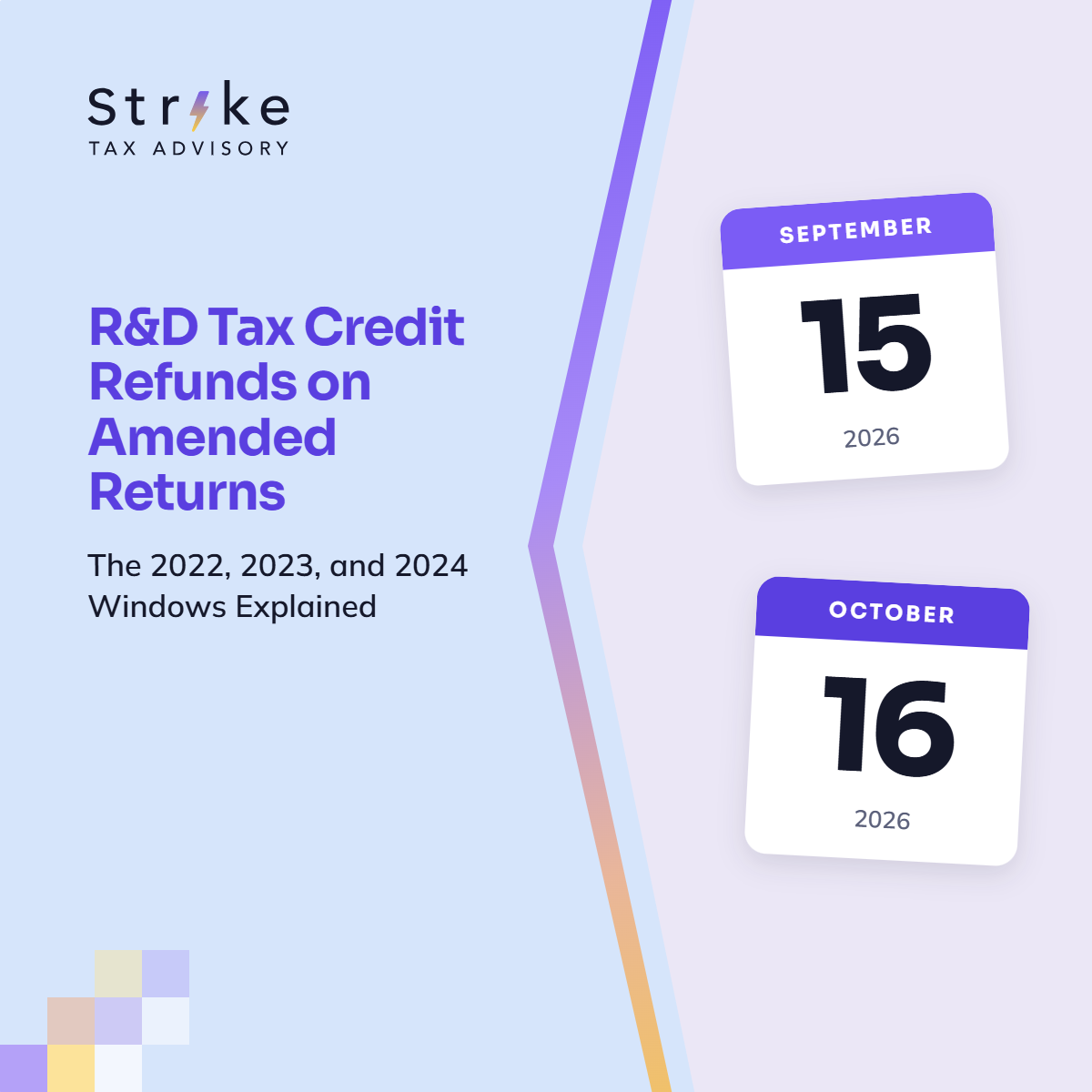
- *Taxpayers that extended their filing deadline would be 9/15 for pass-through entities and 10/15 for C corps.
- The 2022 deadlines are 8-12 weeks away. If you filed on extension, you may have slightly more time, but not much. It typically takes 4-8 weeks to complete an R&D tax study. For timely filers, now is the time to move.
Note: If you amortized your domestic R&D expenses, whether you took the R&D tax credit or not, under Section 174’s prior requirements (pre-OBBBA), there is also a hard stop of July 6, 2026 for the special retroactive election, regardless of individual filing dates. These taxpayers potentially stand to gain even more by reversing their previous Section 174 amortization.
Bottom line: If you want to recover 2022 credits, you need to start now.
Why Most Companies Don't Know About This
Three reasons:
1. The law change was buried.
The One Big Beautiful Bill Act passed in July 2025 with hundreds of provisions. The retroactive R&D fix got minimal coverage.
2. The original problem was confusing.
Starting in 2022, businesses had to amortize R&D expenses over 5 years instead of deducting them immediately. This made the math complicated enough that many companies, and their accountants, stopped taking the credit and or performing R&D.
3. Most CPAs are focused on current-year filings.
Tax season means preparing 2024 returns, not going back to look at 2022-2023. This opportunity requires someone to proactively flag it.
We're not saying your CPA missed something obvious. We're saying this is a specialty area, and it's easy for it to fall through the cracks, especially now, when everyone is slammed with filing season.
What You Should Do Next
Option 1: Ask your CPA directly
Send them this question:
"With the OBBBA retroactive repeal of Section 174 amortization, do we have an opportunity to amend prior year returns (2022-2024) to claim R&D tax credits? What's the deadline for 2022?"
Did we amortize any of our Section 174 R&D expenses? If so, should we consider reversing the amortization?
If they're aware of the opportunity and have already evaluated it for you, great. If not, it's worth a deeper conversation.
Option 2: Get a quick assessment from a specialist
We do R&D tax credit studies exclusively. No tax prep, no compliance work, just R&D credits. We can usually tell you within 15-30 minutes whether you have a meaningful opportunity and give you a rough estimate of the opportunity.
No cost, no obligation. If there's nothing there, we'll tell you.
What's the risk of an IRS audit?
- 1-3% of R&D tax credits are reviewed by a tax authority. This is not a full tax return audit, but a review of the basis for your R&D tax credit claim.
- With the passage of the OBBBA, the IRS will see a flood of nearly identical Section 174 amendments from small businesses. Everyone is filing for the same reason, so it is not a red flag.
• Auditing companies for correctly claiming a benefit Congress explicitly authorized is not a priority. The IRS has bigger targets.
• This is not an aggressive position. OBBBA explicitly permits small businesses to amend 2022-2024, and Rev. Proc. 2025-28 spells out the process.
• IRS audit selection models flag anomalies. A Section 174 amendment that matches the expected pattern is not an anomaly. - Working with Strike Tax Advisory as your R&D tax credit provider means that any request for information or audit will be supported and resolved by Strike. Other providers bill by the hour, and if the credit study is shortcut, it is unlikely you will pass an audit.
The Technical Details (For Those Who Want Them)
Skip this section if you're not a tax professional or just want the executive summary above.
What Changed
The Tax Cuts and Jobs Act (TCJA) of 2017 included a provision, delayed until 2022, requiring businesses to capitalize and amortize domestic R&D expenses over 5 years (15 years for foreign R&D) under IRC §174, rather than deducting them immediately.
This created two problems:
- Immediate cash flow hit: Companies couldn't deduct R&D expenses in the year incurred
- Credit calculation complexity: The interaction between §174 amortization and §41 R&D credits created uncertainty Many companies responded by reducing or eliminating R&D credit claims during 2022-2024.
The OBBBA Fix
The One Big Beautiful Bill Act, signed July 4, 2025, introduced IRC §174A, which:
- Restores immediate expensing for domestic R&D costs starting in 2025
- Provides retroactive reversal of any Section 174 amortization for eligible small businesses (≤$31M average gross receipts under §448(c)) to amend 2022-2024 returns
- Requires election for all three years if claiming retroactive relief (cannot cherry-pick individual years) Foreign R&D expenses remain subject to 15-year amortization.
Key Deadlines
- July 6, 2026: Hard deadline for retroactive §174A election (one year from enactment)
- Standard §6511 limitations: 3 years from filing date for each tax year
- Effective deadline: Earlier of July 6, 2026 or standard limitation for each year For calendar-year 2022 returns filed on time:
- Partnerships/S-Corps (March 15, 2023 filing): March 15, 2026
- C-Corps (April 15, 2023 filing): April 15, 2026
§280C Considerations
Amended §280C(c) requires either:
- Reducing deductions by the gross credit amount, OR
- Electing a reduced credit (~15.8% instead of 20%) with no add-back Rev. Proc. 2025-28 provides transition guidance allowing late §280C elections/revocations for 2022-2024 amended returns.
Aggregation Rules
The $31M gross receipts test under §448(c):
- Averages prior 3 tax years
- Aggregates controlled groups and affiliated entities
- Prorates for short tax years
- Inflation-adjusted annually
State Conformity
State treatment varies significantly:
- Rolling conformity states: Generally follow federal §174A treatment
- Fixed-date conformity states: May require separate state amendments
- Decoupled states (CA, NJ, others): Maintain TCJA amortization rules; separate modeling required
Ready to Find Out If You Have Money Sitting There?
The math is simple: if you did qualifying R&D work in 2022-2024 and didn't claim full credits, you likely have a recovery opportunity. The only question is how much, and whether you act before the deadlines close.
If you missed claiming the R&D credit in prior tax years, you can file amended returns to recover those savings. Walk through the full process in our guide on how to claim your R&D tax credit.
We'll tell you if there's an opportunity, estimate the size, and explain next steps. If there's nothing there, you'll know, andSS you can stop wondering.
Strike Tax Advisory specializes exclusively in R&D tax credit studies. We work with companies across manufacturing, software, engineering, and technology to identify and document qualifying activities. Success-fee pricing. Unlimited audit support.
Frequently Asked Questions
You don't necessarily. But R&D credits are a specialty, most CPAs don't do them in-house. We work alongside your CPA, not instead of them. We handle the technical R&D study; they file the amended returns.
That's what the assessment is for. Most companies underestimate what qualifies. The IRS definition of R&D is much broader than "inventing something new." Learn more about qualifying activities on IRS.gov.
Typically 6-8 months after filing the amended return. The IRS is working through a backlog, but amended returns with refund claims do get processed.
We work on a success-fee basis. You pay a percentage of the credits we identify, nothing upfront, nothing if we don't find credits.
Many states have R&D credits that piggyback on the federal credit. We can evaluate those too, though state rules vary. Check state conformity details.
Yes, including Rev. Proc. 2025-28 for transitions, elections, and method changes. Consult a specialist to avoid mistakes. Read more on common pitfalls.
Related Articles