R&D Tax Credits and OBBBA: Five Costly Mistakes to Avoid When Filing Retroactive Claims
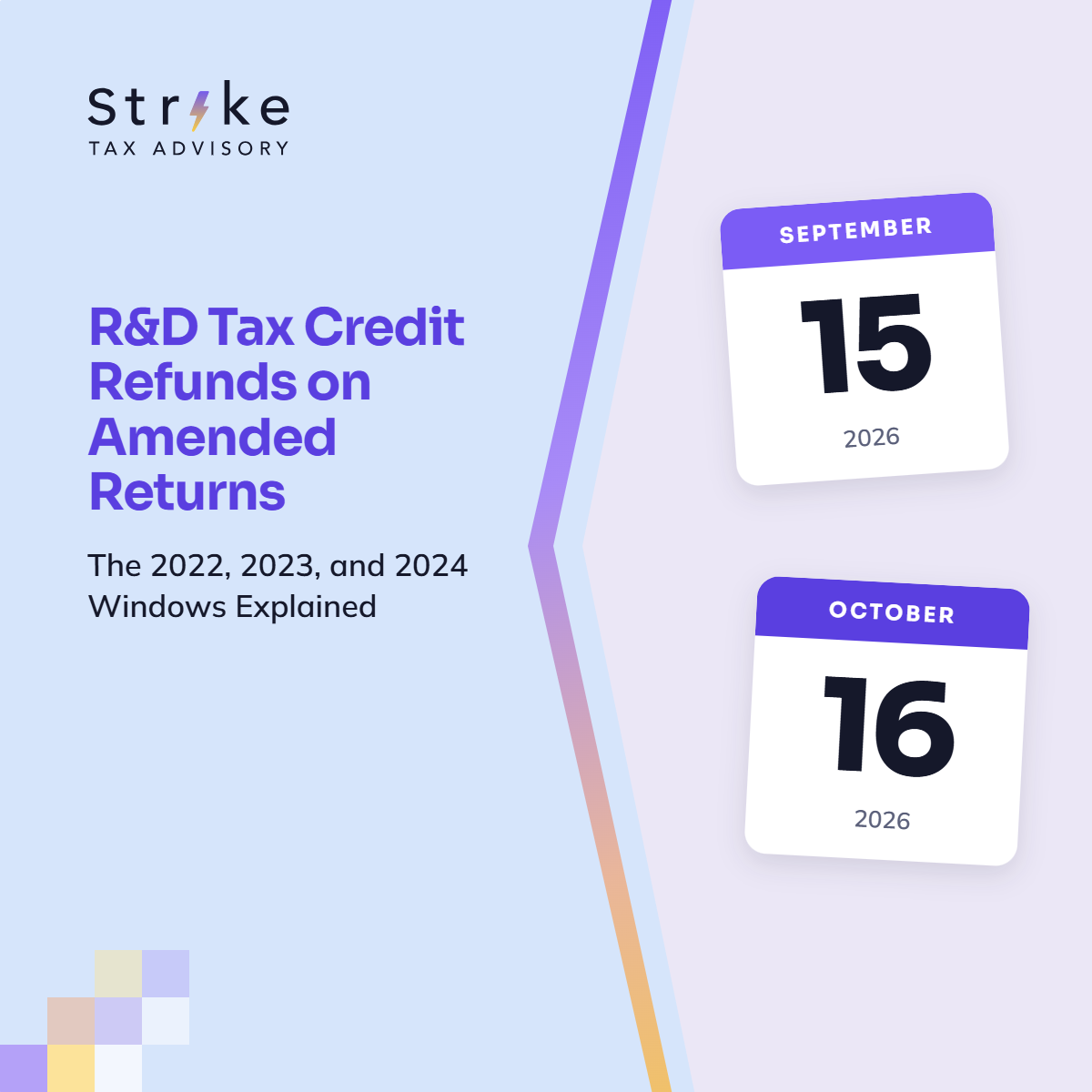
Critical Deadlines at a Glance
Key Takeaways:
The One Big Beautiful Bill Act (OBBBA) was signed into law on July 4, 2025. It permanently restores full R&D expensing under Section 174A and allows eligible small businesses (average annual gross receipts of $31 million or less) to retroactively expense 2022-2024 costs. The retroactive election window closed on July 6, 2026. The claim perfection window runs through January 10, 2027, and Form 6765 Section G becomes mandatory for tax year 2026, so documentation and implementation path mistakes remain live risks for open year claims and catch-up filings. Here are the five most common (and expensive) pitfalls:
Failing to claim retroactive expensing for 2022-2024 via timely amendments forfeits significant deductions, enhanced Section 41 credits, and NOL carrybacks. This often stems from mishandling aggregation rules under Section 448(c).
Treating R&D expensing, credits, and the reduced credit election separately risks miscalculations, double benefits, or underclaims. This can trigger IRS audits and 20% accuracy-related penalties.
Submitting incomplete support (missing the required categories or four-part qualified research test details) leads to automatic denials. There is limited time to perfect claims before January 10, 2027.
Defaulting to full amendments instead of optimal automatic method changes (Rev. Proc. 2025-23/28) drives up costs and creates mismatches with financial statements or state returns.
Overlooking state-specific rules misses additional credits in over 30 conforming states and risks inconsistencies in decoupled ones (e.g., California).
Avoiding these errors can unlock tens or hundreds of thousands in refunds. Read on for detailed fixes, best practices, and official guidance.
Introduction
The One Big Beautiful Bill Act (OBBBA), signed into law on July 4, 2025, permanently restores full expensing for domestic R&D expenditures under new Section 174A. For eligible small businesses, those with average annual gross receipts not exceeding the 2025 inflation adjusted threshold of $31 million, the law created a powerful opportunity: retroactive expensing for tax years 2022-2024 via amended returns.
The opportunity came with strict deadlines. Small business retroactive elections had to be filed by July 6, 2026 or the IRC Section 6511 statute of limitations, whichever came earlier, and that window has closed. The documentation, modeling, and state issues below still apply to open year credit claims and catch-up filings.
This guide details the five most common mistakes that lead to disallowed credits, accuracy-related penalties under Section 6662 (up to 20%), and missed refunds. Understanding these pitfalls can help you navigate the surge in retroactive R&D tax credit claims under Section 41 while avoiding IRS scrutiny.
Many businesses that benefited from OBBBA also meet the IRS Four-Part Test for the ongoing R&D tax credit. Find out if your company qualifies for the R&D tax credit.
What OBBBA Changed for R&D Deductions and Credits
OBBBA permanently reversed the TCJA's mandatory capitalization requirement for domestic R&D, providing relief and transition rules:
For Tax Years After December 31, 2024
- Immediate deduction: Domestic R&D expenses are immediately deductible under Section 174A
- Elective amortization: Taxpayers may elect to capitalize and amortize over at least 60 months (or 10 years under Section 59(e))
- Foreign R&D unchanged: Foreign R&D continues to require 15-year amortization regardless of funding status
- Permanence: unlike earlier legislative proposals, Section 174A is permanent; there is no sunset provision
Small Business Retroactive Election
Eligible small businesses could elect to apply Section 174A retroactively to tax years beginning after December 31, 2021. Requirements include:
- Meeting the Section 448(c) gross receipts test (≤$31M average, including controlled group aggregation)
- Not being classified as a tax shelter
- Making the election on amended returns for each applicable year
- Critical: The election had to be filed by July 6, 2026 or the IRC 6511 statute of limitations, whichever came earlier. The window has closed.
Deemed Election for 2024 Returns
Per Rev. Proc. 2025-28, calendar-year small businesses filing original or superseding 2024 returns on or before November 15, 2025 will be deemed to have made the election if they deduct domestic R&D expenses on the return and otherwise comply with requirements.
Superseding Return Extension
Rev. Proc. 2025-28 grants an automatic six-month extension from the original due date for filing superseding 2024 returns. This relief is critical for taxpayers who filed their 2024 returns before OBBBA guidance was available.
Catch-Up Acceleration for All Taxpayers
All taxpayers (not just small businesses) can accelerate unamortized 2022-2024 domestic R&D costs into 2025 or spread them over 2025-2026 using automatic method changes under Rev. Proc. 2025-23 and 2025-28. Key considerations:
- The accounting method change uses a Section 481(a) adjustment to accelerate unamortized costs
- For 2025 year-of-change, Form 3115 is waived; a statement in lieu can be filed instead.
- Some method changes provide audit protection; others do not
Section 280C Coordination
OBBBA allowed small businesses to make late Section 280C (c)(2) elections or revocations on amended returns filed during the one-year period that ran from July 4, 2025, through July 6, 2026. That window has closed. The coordination point still matters historically: taxpayers who retroactively applied Section 174A also had to address 280C treatment.
Refund Claim Documentation Requirements
For R&D credit refund claims postmarked after June 18, 2024, the IRS requires three categories of information:
- Identification of all business components to which the Section 41 credit relates
- Description of research activities performed for each business component
- Total qualified employee wage, supply, and contract research expenses for the claim year
The 45-day perfection transition period extends through January 10, 2027. Note: For BBA partnerships filing AARs, additional documentation requirements apply.
If your business has qualifying research expenses, you may be able to claim credits for open tax years. Here's how to claim your R&D tax credit step by step.
Form 6765 Section G Requirements
- Tax Year 2025: Section G is optional for all filers
- Tax Year 2026: Section G becomes mandatory, with exceptions for:
— Qualified small business (QSB) taxpayers under IRC Section 41(h)(3) electing the payroll tax credit
— Taxpayers with QREs ≤ $1.5 million AND gross receipts ≤ $50 million (at control group level) on original returns
How Retroactive Claims Boosted a Tech Group's Credits
Illustrative example based on common scenarios.
A software development firm with $20 million in average gross receipts qualifies as a small business under Section 448(c). For 2022-2024, the firm capitalized $7.2 million in domestic R&D (excluding foreign costs) and claimed $460,000 in credits using the Alternative Simplified Credit (ASC) method.
Post-OBBBA, the firm elected retroactive expensing and amended returns before the July 6, 2026 window closed:
- Total QREs aggregated: $7.2 million
- Three-year average QREs: $3.6 million
- Recalculated ASC credit: 14% × ($7.2M − 0.5 × $3.6M) = 14% × $5.4M = $756,000
Section 280C adjustment: Using a 35% reduction for illustration; actual adjustment depends on the taxpayer's method election.
Outcome: Cumulative refunds from expensing exceed prior amortization by $1.5 million, plus enhanced credits. Proper controlled group aggregation avoided underclaims commonly seen in multi-entity audits.
Five Common Mistakes in Retroactive R&D Claims
Mistake 1: Ignoring the Small Business Retroactive Election (window now closed)
Overlooking OBBBA's option for eligible firms to expense 2022-2024 costs retroactively via amendments, assuming only forward relief applies.
Why it hurts: Forfeits immediate deductions and credit boosts; misses NOL carryback opportunities. Many small businesses fail the gross receipts test due to unaggregated controlled group entities.
How to fix:
- Test eligibility under Section 448(c), including aggregation for controlled groups under IRC Section 52
- Model three scenarios: retroactive expensing, catch-up acceleration, or hybrid approach
- The window closed on July 6, 2026. Companies that missed it should model the catch-up acceleration under Rev. Proc. 2025-23 and 2025-28 and evaluate open year Section 41 claims instead
Risk level: Realized for the election itself; the recoverable paths above remain.
Mistake 2: Modeling Section 174, 41, and 280C in Silos
Handling deductions, credits, and 280C elections independently, leading to miscalculations.
Why it hurts: Creates double benefits or underclaims; invites 20% penalties under Section 6662 for negligence or substantial understatement.
How to fix:
- Build a unified model integrating deductions, credits, and 280C elections
- Incorporate NOLs and profit projections for 2025-2027
- Document all elections to defend against negligence claims
Risk level: High — material underpayments trigger penalties.
Mistake 3: Weak Documentation for Refund Claims
Submitting refund claims without the three required categories of information for claims postmarked after June 18, 2024.
Why it hurts: A significant portion of amended claims are rejected due to documentation deficiencies. The perfection window extends only through January 10, 2027. Claims must also support the four-part test (technological purpose, uncertainty, experimentation, and process of evaluation).
How to fix:
- List all business components and activities meeting Section 41 criteria
- Tie totals to Form 6765 with detailed payroll, supply, and contractor workpapers
- Prepare for mandatory Section G in 2026 by organizing project-level documentation now
Risk level: Very high — full denial is possible.
Mistake 4: Choosing the Wrong Implementation Path
Defaulting to full amendments without evaluating method changes under Rev. Proc. 2025-23/28.
Why it hurts: Raises compliance costs and creates potential inconsistencies in financial statements or state filings.
Implementation paths:
Note: BBA partnerships must use AARs rather than traditional amended returns.
Risk level: Moderate-high — unnecessary complexity and potential inconsistencies.
Mistake 5: Ignoring State Conformity
Focusing solely on federal treatment while overlooking state-specific rules.
Why it hurts: Misses credits available in over 30 states; creates mismatches where states decouple from federal treatment. California, for example, conforms to pre-TCJA Section 174 rules and has a fixed reference to Section 41 as of 1996, requiring careful analysis.
How to fix:
- Create a conformity matrix (automatic vs. static conformity to IRC)
- Prioritize states with high exposure (CA, NY, TX)
- File state amendments in parallel, tracking local statutes of limitations
Risk level: Moderate — dollar impact can be significant.
Best Practices for Compliance
- Confirm eligibility early with Section 448(c) review, especially after M&A transactions
- Integrate modeling across 2022-2025, including Section 163(j) interest limitations and 199A impacts
- Build component-level documentation aligned with IRS Audit Techniques Guide for the R&D credit
- Leverage method changes for efficiency via Rev. Proc. 2025-23/28 where appropriate
- Coordinate with financial teams for ASC 740 tax provision and state conformity analysis
Official Sources
- IRS Rev. Proc. 2025-23/28 (method changes).
- IRS Form 6765 instructions (2025) and research credit FAQs.
- IRC Sections 174A, 41, 280C, 448(c), 6511.
Disclaimer: This article is for general informational purposes only and does not constitute tax, legal, or financial advice. Each taxpayer's situation is unique; consult a qualified tax professional for advice tailored to your circumstances.
Frequently Asked Questions
Not any longer. The election window, the earlier of July 6, 2026 or the Section 6511 statute of limitations, has closed. Remaining capitalized amounts can be recovered through the catch-up deduction starting with 2025 returns.
No. Options include: (1) continuing amortization, (2) accelerating remaining costs into 2025/2026, or (3) retroactive expensing if qualified. The optimal choice depends on profitability and credit utilization.
No retroactive election is available, but you can use catch-up acceleration for 2022-2024 unamortized domestic costs. Full expensing applies starting 2025.
Section 174A is permanent. Unlike earlier legislative proposals that included sunset provisions, the enacted OBBBA made domestic R&D expensing permanent.
Small businesses could make late 280C(c)(2) elections or revocations on amended returns during the one year window that ran from July 4, 2025 through July 6, 2026. July 4, 2026 fell on a Saturday, so the deadline rolled to Monday, July 6. That window has closed.
No, Section G is optional for tax year 2025. It becomes mandatory in 2026 with exceptions for QSB payroll credit filers and taxpayers with QREs ≤$1.5M and gross receipts ≤$50M.
Related Articles