R&D Tax Credit Refunds on Amended Returns: The 2022, 2023, and 2024 Windows Explained
Key Takeaways
- The July 6, 2026 deadline applied to a retroactive Section 174A expensing election for eligible small businesses, not to the R&D credit itself.
- The federal R&D tax credit can still be claimed for 2022, 2023, and 2024 by filing an amended return within the three-year refund window.
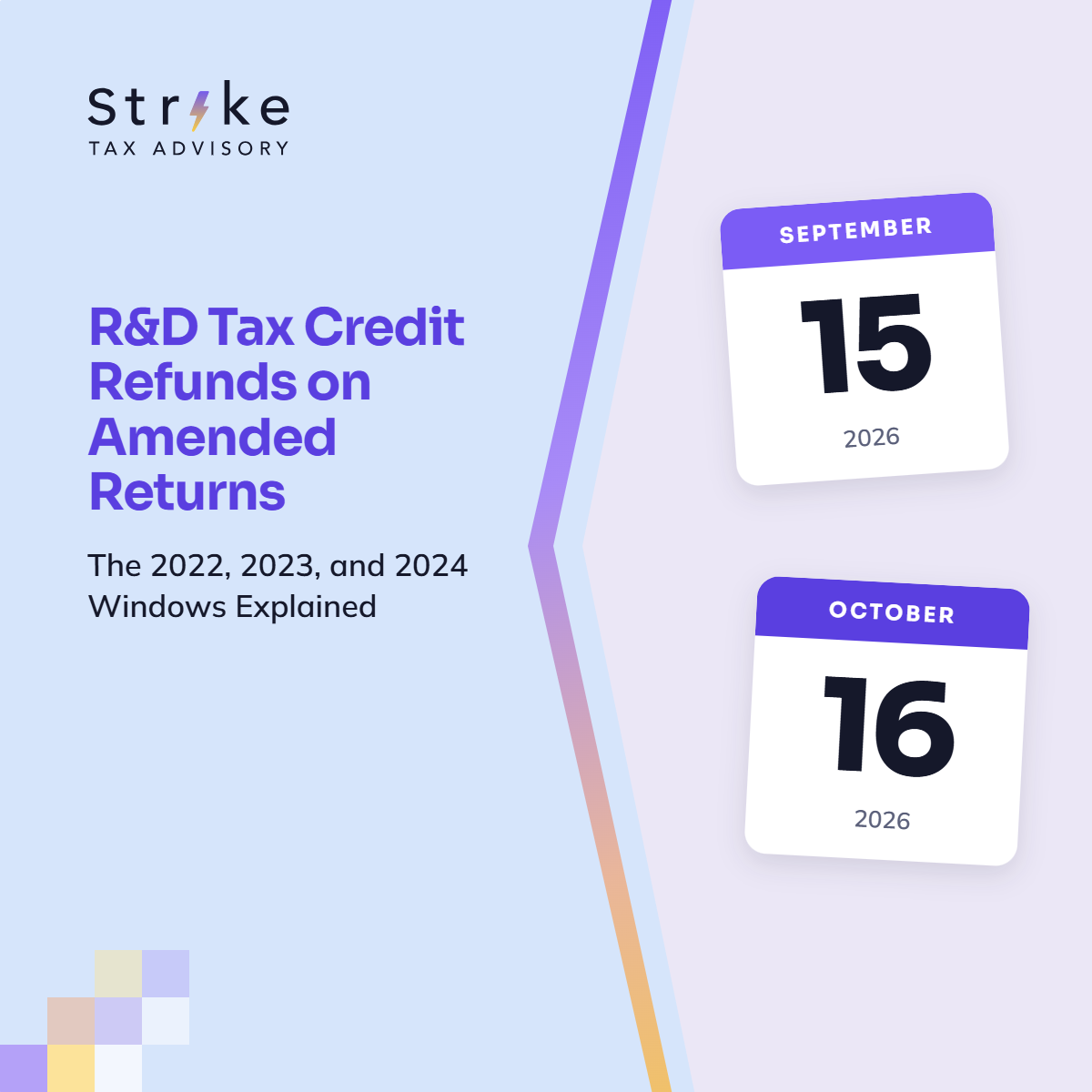
- For calendar-year 2022 returns filed at the extended deadline, the outside dates are September 15, 2026 for partnerships and S corporations and October 16, 2026 for C corporations. Filing earlier in the extension period means an earlier cutoff.
- A valid refund claim must identify business components, describe the research activities for each, and report total qualified wage, supply, and contract research expenses.
- The 2023 and 2024 windows run into 2027 and 2028, which leaves room to do this properly.
- State R&D credits follow the same playbook: many states model their credit on the federal one, and amended state returns run on each state's own refund window.
Yes, companies can still claim the federal R&D tax credit for 2022, 2023, and 2024. The July 6, 2026 deadline closed a separate Section 174A expensing election, not the credit. A refund claim stays open for roughly three years after each return was filed, which keeps 2023 and 2024 fully open and many extended 2022 filers eligible into fall 2026.
This guide walks through what actually closed in July, how the refund window is measured, the dates that matter for each open year, what the IRS requires in the claim itself, and how the filing works for each entity type.
Did the R&D Tax Credit Deadline Pass on July 6, 2026?
No. July 6, 2026 was the deadline for a specific election under Rev. Proc. 2025-28, not for the R&D credit. Under the One Big Beautiful Bill Act, eligible small businesses (generally those under $31 million in average annual gross receipts) could elect to apply new Section 174A expensing retroactively to 2022 through 2024, and certain late Section 280C elections rode along with it. That election window closed.
The credit itself lives in Section 41 of the tax code and was never subject to that date. If your company performed qualified research in 2022, 2023, or 2024 and never claimed the credit, the path to a refund runs through an amended return, governed by the ordinary refund statute. And claiming the credit does not require the 174A election: companies that capitalized research costs under prior law can still claim it for those years. For the deduction side of the story, see our OBBBA refund guide.
How Does the Three-Year Refund Rule Work?
A refund claim is generally timely if it is filed within three years of the date the return was filed, or within two years of when the tax was paid, whichever is later, under Section 6511 of the Internal Revenue Code. Two mechanics decide what that means for your calendar:
- Early filers count from the due date. A return filed before its original due date is treated as filed on the due date. A 2022 return submitted in February 2023 starts its three-year clock in spring 2023, not February.
- Extension filers count from the actual filing date. A return filed during an extension period starts the clock on the day it was actually filed. This is why the fall 2026 dates matter: calendar-year 2022 returns filed at the extended deadlines in September and October 2023 reach the end of their three-year windows in September and October 2026.
A second limit also applies: the refund cannot exceed the tax paid during the lookback period, generally the three years before the claim plus any filing extension. Most companies that paid their tax at the normal time and claim within the three-year window will find those payments covered. Before any claim is filed, we confirm this from the payment history.
Which Tax Years Are Still Open, and Until When?
For most companies, 2023 and 2024 are comfortably open, and 2022 is open only for those that filed on extension. Here is the picture for calendar-year filers as of August 2026:
Two cautions. First, these are outside dates for returns filed at the extended deadline. A 2022 return filed in July 2023, mid-extension, has a July 2026 cutoff that has already passed. The controlling date is your actual filing date, so confirming it from your filing records is the first real step. Second, fiscal-year filers run on their own calendar; the same three-year logic applies from their filing dates.
What Must an Amended R&D Credit Refund Claim Include?
A research credit refund claim is only valid if it gives the IRS enough specific information to evaluate it, and the IRS has told taxpayers exactly what that means. Since June 18, 2024, a claim must include three items:
- The business components to which the Section 41 claim relates for that year.
- The research activities performed for each business component.
- The totals for qualified employee wage expenses, qualified supply expenses, and qualified contract research expenses for the claim year.
The credit is computed on Form 6765; the claim detail is filed with the amended return and can be reported on Form 6765's business component section. A refund claim that arrives without the required information is not a weaker claim; it risks being an invalid one. The IRS currently mails a letter giving 45 days to perfect a deficient claim, a grace period that runs through January 10, 2027, and it has stated it aims to make determinations on these claims within six months of receipt.
This is why a credible amended claim is study work, not paperwork. Identifying what counts as qualified research, tying activities to business components, and building the expense totals is the substance; the forms are the wrapper.
How Do You Claim the Refund, Step by Step?
The process is the same one used when the credit is claimed on an original return, with an amendment vehicle wrapped around it:
- Confirm each year's actual filing date. Pull the filed returns or transcripts. Early filings count from the due date; extension filings count from the day filed. This sets your real deadline per year.
- Confirm eligibility and build the study. Document the qualified activities, the business components they belong to, and the qualified research expenses behind them, year by year.
- Compute the credit on Form 6765 for each claim year, with the claim information the IRS requires.
- File the right amendment for your entity type (covered next), attaching the credit computation and claim detail.
- Track the claim and respond fast if the IRS asks for more. The 45-day perfection window is short, and complete responses keep a claim alive.
Which Forms Apply to Your Entity Type?
The credit is the same; the amendment vehicle changes with the entity:
- C corporations file Form 1120-X for each open year.
- Individuals, including sole proprietors and owners receiving flow-through credits, file Form 1040-X.
- S corporations amend Form 1120-S and issue corrected Schedules K-1, and shareholders then amend their own returns to capture the credit.
Partnerships are the exception: most cannot simply file an amended Form 1065. They generally file an administrative adjustment request, an AAR, under the Bipartisan Budget Act rules. The AAR deadline runs under Section 6227 rather than Section 6511: three years from the later of the date the partnership return was filed or its unextended due date, with no two-years-from-payment alternative, and for extended filers the math lands on the same dates shown in the table above. The benefit also arrives differently: an AAR adjustment generally flows through the partners' current-year returns rather than as a direct refund check for the prior year.
Two elections deserve a flag because they cannot be fixed by amendment. The election to apply the credit against payroll taxes is available only on a timely filed original return, so a loss-stage company amending for prior years establishes a credit that carries forward, generally for up to 20 years, rather than a payroll-tax refund. And how the credit interacts with your deduction under Section 280C depends on elections made with the original filing; that interaction gets worked out inside the study, not guessed at.
Can You Amend State Returns for State R&D Credits Too?
Yes. Many states offer their own R&D credit modeled on the federal Section 41 credit, and the recovery path is the analog of everything above: an amended state return filed inside that state's refund window.
Most state credits borrow the federal definitions of qualified research and qualified research expenses, usually limited to research performed in that state, so the same study that supports the federal claim generally carries the state claim. Rates, carryforwards, and refundability vary widely by state, which is why the state-level answer is always specific; our state R&D credit guides cover each state's rules.
Two things change at the state line. First, state refund windows are not automatically three years. Each state sets its own limitations period, sometimes running from a different trigger than the federal clock, so state deadlines are confirmed state by state alongside the federal dates. Second, an amended federal return usually has to be reported to the state anyway. In some states a reported federal change also adjusts the time to claim a state refund. Filing the federal and state amendments as one coordinated package avoids doing the work twice.
Where research happens in more than one state, each state's credit and window stands on its own, the same way each federal year does.
What Should You Do Now, in August 2026?
The honest answer depends on which year you are looking at. For 2022, the task this month is verification, not panic: pull the actual filing date for the 2022 return. If your company is a partnership or S corporation that filed at the September 2023 extended deadline, the outside date is September 15, 2026. If it is a C corporation that filed at the October 2023 extended deadline, the outside date is October 16, 2026 (October 15, 2023 fell on a Sunday, so the extended deadline moved to Monday, October 16). If the return went in earlier during the extension period, the window may already be closed, and knowing that early saves everyone time.
For 2023 and 2024, the windows run into 2027 and 2028. That is the room to do this properly: a defensible claim needs the study behind it, and the IRS's own validity standard rewards specificity over speed. As a working rule, give a claim at least two months of runway before its outside date.
If R&D credit work never made it onto your returns for these years because of the Section 174 capitalization era, you are exactly the company this window exists for. Start with the filing dates, then let the numbers tell you whether the claim is worth pursuing.
Disclaimer: This article is for general informational purposes only and does not constitute tax, legal, or accounting advice. Refund deadlines depend on your company's actual filing dates, payment history, entity structure, and applicable law. Consult a qualified professional regarding your situation.
Frequently Asked Questions
No. July 6, 2026 was the deadline under Rev. Proc. 2025-28 for eligible small businesses to elect retroactive Section 174A expensing, along with certain late Section 280C elections. The refund window for the R&D credit itself runs under the general three-year rule and remains open for 2023, 2024, and for many 2022 filers who extended.
Generally three years from the date each return was filed, or two years from when the tax was paid, whichever is later. Returns filed early count as filed on the due date, while returns filed on extension count from the actual filing date. That keeps 2023 and 2024 open and gives many extended 2022 filers until September 15 or October 16, 2026.
Three things, filed with the amended return: the business components the claim relates to, the research activities performed for each component, and the total qualified employee wage, supply, and contract research expenses for the claim year. The credit itself is computed on Form 6765. If the IRS finds a claim deficient, it currently mails a letter giving 45 days to perfect it.
C corporations file Form 1120-X. Individuals, including owners of pass-through entities, file Form 1040-X. S corporations amend Form 1120-S and issue corrected K-1s so shareholders can amend their own returns. Most partnerships file an administrative adjustment request under the Bipartisan Budget Act rules instead of a conventional amended return.
No. The election that applies the credit against payroll taxes must be made on a timely filed original return, so it cannot be added by amendment. Companies without income tax liability can still establish the credit on an amended return and carry it forward, generally for up to 20 years.
Any refund claim can be selected for review, and research credit claims carry specific documentation requirements precisely so the IRS can evaluate them. A claim built on a proper study, with business components, activities, and expense totals documented, is in a far stronger position than one assembled from estimates. Strike supports every claim it prepares through IRS examination.
Timelines vary with IRS workload and claim complexity, so plan on months rather than weeks from filing to refund. The IRS has stated it aims to make determinations on research credit refund claims within six months of receipt.
Related Articles