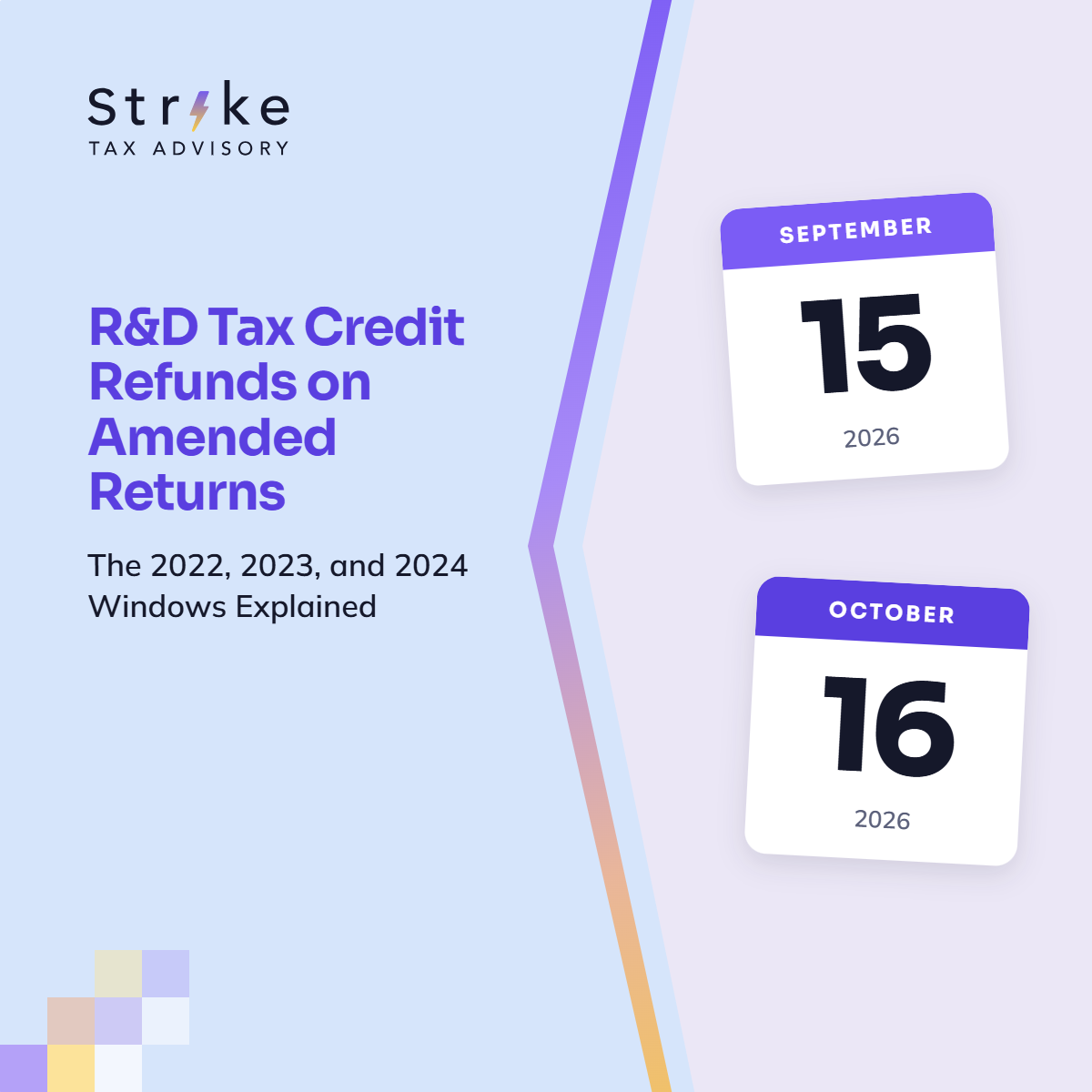
Medical Cannabis Operators: The Deadline to Get Your 2022 Taxes Back Is October 16
Key Takeaways
If you grow, extract, manufacture or dispense cannabis under a state medical license, the federal tax rules changed for you this spring. What did not change is the clock on the tax you already paid, and the first of those deadlines is next month.
What Changed in April
On April 22, 2026 the Acting Attorney General signed a final order, effective the same day, moving state-licensed medical marijuana and FDA-approved cannabis products from Schedule I to Schedule III of the Controlled Substances Act. The Justice Department announced it on April 23 and it was published in the Federal Register on April 28. Adult-use cannabis stayed in Schedule I; a DEA hearing on moving it ran this summer and no decision has come out.
That matters because of one tax provision, Section 280E. It says a business trafficking in Schedule I or II substances cannot deduct ordinary expenses. Rent, payroll, utilities, marketing, the cost of a test run on a new strain: none of it counted. Only cost of goods sold survived. You were taxed on gross profit instead of net income, at effective federal rates well above what any comparable business pays. The same section blocked every federal tax credit, including the research credit that farms, food processors and manufacturers claim for exactly the kind of trial and error a cultivation or extraction operation does every day.
What Did Not Change
Nothing in the order gives back a dollar of the tax you paid for 2022, 2023, 2024 or 2025. The order encourages Treasury to consider relief for those years. Treasury's April 23 announcement covered 2026 and said nothing about earlier years. And the last thing the IRS said in Tax Court on the subject, in a case out of New Mexico briefed in March before the order, was that every year cannabis sat in Schedule I is owed in full. The IRS has not said anything since, and the court has not ruled.
Meanwhile, the deadline to ask for that money back is expiring one year at a time. The IRS gives you three years from the day you filed a return to request a refund for it. After that, the year is closed for good. If Treasury announces retroactive relief in 2027 and your 2022 year closed in 2026, you get nothing for 2022.
This post is about how to keep those years alive until Treasury decides.
What a Protective Refund Claim Is
A protective claim is a refund request that says, in effect: I may be owed money for this year depending on something that has not happened yet, so do not let the clock run out on me. The IRS has accepted these for decades, usually when a court case or new guidance is pending. It does not process the claim; it puts it on hold and comes back to it once the open question is answered.
Filing one does not require you to know the exact dollar amount. It does require naming the year, naming the open question (here, whether Treasury grants retroactive 280E relief for state-licensed medical activity) and describing what you would be claiming. It goes in on the same amended-return forms a normal refund would, marked "protective claim" at the top. Once Treasury decides, the claim is updated with the actual dollar amount. Which form depends on how your business is set up; your CPA handles that part, and the details are in the CPA section at the end of this post.
Two things it is not. It is not a demand that the IRS write a check now. And it is not the amended return the IRS warned operators about in June 2024, when it said refund claims for 280E tax would be denied as long as cannabis was Schedule I. That warning was about claims that argue 280E never applied. A protective claim does not argue that. It says the rules may be changing and asks the IRS to hold the year while they do.
Which Years Are at Risk, and When
If your business files on a calendar year, the windows look like this. The clock runs from the day you actually filed, so check your own dates.
One protective claim can cover every open year at once. There is no reason to file for 2022 now and come back for 2023 later.
The Credit You Were Not Allowed to Claim
Most operators think of 280E as a deduction problem, because that is where the pain showed up every year. It was also a credit problem. Every other agricultural and manufacturing business in the country can claim a federal research credit for work that involves testing and iteration: cultivation trials, genetics, developing an extraction or purification process, formulating a dosage form, building an analytical method, scaling a process up. The credit is a share of what the company spent on wages, supplies and contractors for that work, and for a cultivation or extraction operation it is not a small number.
Medical cannabis companies do that work constantly. Under 280E it produced nothing. If Treasury grants retroactive relief, the credit for those years comes back along with the deductions, but only if the claim asks for it. A protective claim that only mentions deductions can leave the credit behind.
The IRS has specific requirements for research credit refund claims: which products or processes the research was for, what the research involved, and what was spent on it. That is study work, and it is far easier to do while the people who ran the trials still work for you. Not sure whether your cultivation or extraction work counts? The four-part test is explained in our guide to R&D tax credit eligibility.
Does Claiming the Credit for 2026 Hurt My Chances for Earlier Years?
No. The 2026 credit stands on its own under the full-year rule Treasury described. Claiming it does not affect whatever Treasury decides about 2022 through 2025, and the documentation you build for 2026 is most of the work for the prior years anyway.
What Operators Are Doing Now
Pulling license records for every open year, to show which rooms, lines and products ran under the medical license and which, if any, ran under an adult-use license. Only the medical activity was rescheduled, and a dual-license operator that cannot separate the two has nothing to claim.
Separating medical from non-medical revenue and cost for each of those years, for the same reason.
Filing protective claims for every open year, naming both the deductions and the research credit.
Documenting the research project by project, so the prior-year credit can be calculated the day Treasury decides, and so the 2026 credit, the first year with no open question, is ready at the same time.
What Strike Does
Strike prepares the license map and the medical versus non-medical segmentation for each open year, identifies and documents the qualifying research, prepares the research credit support in the form the IRS requires, and works with your CPA on the protective claim filing. The engagement is contingent, with no upfront fee. If your 2022 return was filed on extension, the deadline is October 16.
For Your CPA
The order. Final order signed and effective April 22, 2026, published at 91 FR 22714 on April 28, 2026. It places marijuana in FDA-approved drug products and marijuana subject to a qualifying state medical license in Schedule III. It encourages the Secretary of the Treasury to consider providing retrospective relief from Section 280E liability for taxable years in which a state licensee operated under a state medical marijuana license, and disclaims any determination of federal tax liability.
Treasury and IRS, April 23, 2026. Release announces forthcoming guidance and a transition rule under which rescheduling applies for the taxpayer's full taxable year that includes the effective date. For a calendar-year filer, 280E relief runs from January 1, 2026. The release is silent on prior years.
IRS litigating position. Answering brief of March 6, 2026 in New Mexico Top Organics, Inc. v. Commissioner (T.C. Dkt. No. 19661-24), filed before the order, argues 280E applies for every year marijuana was listed in Schedule I and signals Section 6662 penalties for contrary return positions. Taxpayer reply of May 18, 2026 invokes the order; no IRS response in writing and no ruling. See also IR-2024-177 (June 28, 2024).
Limitations. Section 6511(a): three years from filing or two years from payment, whichever is later. Section 6513(a): a return filed before the due date is deemed filed on the due date. Section 6511(b): the lookback caps the refund at tax paid within the applicable period. Extended 2022 calendar-year corporate returns close October 16, 2026.
Protective claim requirements. IRM 4.10.11.2.1.3: in writing and signed; taxpayer name, address and TIN; identify and describe the contingency; sufficiently clear to alert the IRS to the essential nature of the claim; identify the specific years. Amount need not be stated. Claims filed with the campus are generally forwarded to the Technical Services Protective Claims Coordinator for suspense. Write "PROTECTIVE CLAIM" across the top (IRM 21.5.3.4.7.3) and state the contingency in the explanation section (Part II of Form 1120-X). The label alone is not sufficient (CCA 201136021). Perfect the claim with the dollar amount once the contingency resolves. Retain proof of timely filing.
Entity mechanics. C corporation: Form 1120-X. S corporation: amended Form 1120-S plus shareholder Form 1040-X to protect the shareholders' years. Partnership subject to the BBA centralized regime: partners generally cannot protect partnership items on Form 1040-X; the partnership files a protective Administrative Adjustment Request on Form 1065-X or Form 8082.
Section 41 refund claims. Per the IRS amended-return FAQ as revised after the June 18, 2024 waiver, the claim must identify the business components, the research activities performed for each, and the total qualified wage, supply and contract research expenses for the year. Names of individuals and the information sought to be discovered are no longer required with the claim but may be requested on examination. Contract research is included at 65 percent of the qualified amount.
State conformity. Many states decoupled from 280E; state refund limitation periods differ from federal. A federal protective claim does not protect a state year.
Official Sources
- CRS Legal Sidebar LSB11424, the April 22, 2026 final order rescheduling medical marijuana (91 FR 22714)
- Treasury and IRS press release, April 23, 2026, Schedule III transition rule
- Department of Justice press release, April 23, 2026
- 26 U.S.C. section 6511, Cornell Law School LII
- 26 U.S.C. section 6513, Cornell Law School LII
- 26 U.S.C. section 280E, Cornell Law School LII
- Internal Revenue Manual 4.10.11, Claims for Refund (protective claims at 4.10.11.2.1.3)
- Internal Revenue Manual 21.5.3 (protective claim identification at 21.5.3.4.7.3)
- IRS news release IR-2024-177, June 28, 2024
- IRS, Research credit claims (Section 41) on amended returns, frequently asked questions
Disclaimer: This article is for general informational purposes only and does not constitute tax, legal, or financial advice. Treasury has not issued guidance on prior years, and entity type, license structure and filing dates all affect outcomes. Confirm your own filing dates and the correct form with a qualified tax professional before you file.
Work With Strike Tax Advisory
Strike Tax Advisory is an R&D tax credit specialist firm helping innovative businesses across manufacturing, agriculture, engineering, software, and other technical industries claim federal and state research credits.
For a state-licensed medical cannabis operator with open years, our team will:
- Build the license map for every open year and separate medical from non-medical activity
- Identify and document the qualifying research, project by project
- Prepare the research credit support in the form the IRS requires for refund claims
- Work with your CPA on the protective claim filing before each window closes
- Prepare the 2026 claim, the first year with no open question, at the same time
Frequently Asked Questions
The claim itself is an amended return with a short statement attached. The real work is the license map, the segmentation and the research documentation behind it, which Strike prepares on contingency.
Not by itself. The IRS holds protective claims until the open question is resolved, then acts on them. When the claim is eventually processed, the deductions and credit have to be supported the same way any refund claim is, which is why the records need to be assembled now.
Yes, for the medical activity. You need to be able to show which parts of the operation ran under which license in each year. Adult-use activity remains Schedule I and stays under 280E.
It depends on the entity, and it matters: an S corporation amends its own return and the owners file to protect their personal years, while most partnerships have to file at the partnership level, not through the partners. Your CPA handles the mechanics; the point is to get it on their desk before October 16.
Separate question. Many states dropped 280E on their own years ago, and state refund deadlines differ from the federal one. Ask your CPA to check each state you file in.
Nothing yet. The DEA hearing on broader rescheduling has concluded and the record is closed; no decision has issued. Adult-use activity stays under 280E until it does.
Related Articles